


Hi, I’m Katie. Multiple Lives Theory is about the identity side of changing careers, written from inside the change. A new free essay lands every Sunday.
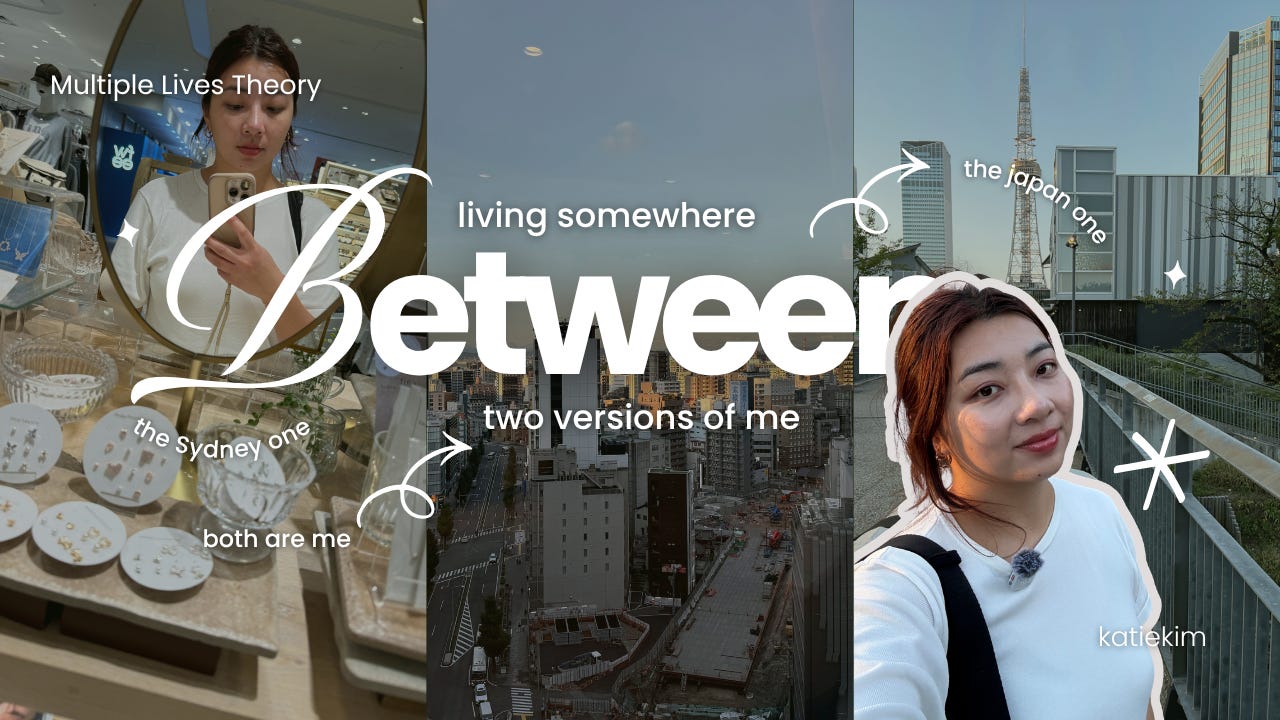
TLDR: I’ve been living between two versions of myself, the one from Sydney and the one that keeps turning up in Japan. For a while I thought I had to pick one. Lately I’ve started to see the in-between as a place where a lot of my actual living happens, and I suspect more of us are standing in it than we let on.
The return of the generalist
I came across an idea recently that we’re entering a second Renaissance.
Some people call it the return of the generalist. It describes a world where we’re no longer defined by one job, one skill or one identity, and where it’s normal to explore several interests and versions of ourselves at once.
It got me thinking.
I’m a different version of myself in Japan than I am in Australia. Different interests, routines and sides of my personality seem to emerge here. Some of them surprised me. Others feel like they were always there and just never had the room.
Two versions, two weeks
In Sydney, the version of me most people knew was organised around work. The stable pay, the impressive tech title, the two small businesses on the side, the house, the full calendar. I used all of it as evidence that I was doing well. I measured my days by output. Even running was partly proof that I was disciplined.
That version wasn’t fake. She was good at a lot of things, and she built a lot. She was also, by the end, very tired of feeling like a walking shell.
The version that shows up in Japan has a different week.
She’s learning Japanese by talking to locals at markets, forgetting words, stumbling and trying again anyway. There’s a ceramics class when she can get to one.
Running happens most days, and the Mt Fuji marathon is on the calendar for the end of the year. Work is a web studio and consultancy, teaching English remotely and writing this newsletter. Evenings sometimes mean a digital nomad meetup, and slowly, more locals.
When I put the two side by side, I can see why it feels like being two people. The longer I’m here, though, the less it feels like I swapped one for the other. I’m living somewhere between them.
What the in-between looks like
The in-between doesn’t look the way I expected.
I pictured a clean break. One life ending, another one starting, a clear line down the middle. In practice it’s much more ordinary than that.
Some evenings I’m sitting on my own in Japan while texting and FaceTiming people back home. One version of me is in the room, and the other is on the screen, and both of them are me.
I wrote a few weeks ago that the version of me I left behind came with me. She did. She comes up in conversations with people from home, in the way I still reach for my calendar, in the instinct to measure a day by what got done.
I used to read that as a sign I hadn’t fully arrived. A proper fresh start, I thought, would mean leaving the old version behind completely.
Now it feels more like what a change looks like from the inside, while you’re still in the middle of it. Two versions overlapping for a while, each taking up a bit more or a bit less space depending on the day.
It shows up in small places.
Even the way I introduce myself has changed. In Sydney I felt a lot of pressure to fit into one neat title, something people could repeat back to me. Here, I say I live as a digital nomad and work on a few things. People nod. Then they either move on or ask about one of them.
That longer, looser answer belongs to the in-between. It wouldn’t have fit the old version, and it might not fit whoever I am in five years. For now, it’s true.
Different versions for different people
For a long time I believed I had to show my whole true self to everyone. Friends, colleagues, my parents, distant cousins. One consistent version, the same in every room, or it didn’t count as honest.
But now I believe you can bring different versions of yourself to different people. As there are probably various versions of us in different people’s minds.
I spent a while wondering whether that made any of them less true. If the person my parents know and the person at the Japanese market are slightly different, which one is lying?
The more I sit with it, the less it looks like lying. Each version is an honest response to the people and the place in front of it. My parents get the version that grew up with them and the role I play with the dynamic that is set at home.
The market gets the version that’s curious and a bit clumsy with the words. Both are telling the truth about who I am in that moment.
That shift has made the in-between feel less like a problem to solve. The Sydney version still turns up when I talk to people from that life. The Japan version turns up at the market, on a morning run, at the pottery wheel. Neither of them is pretending.
I’d always assumed being consistent meant being the same everywhere. Living here, I’ve started to think it means something smaller. Being honest in each place, even when each place gets a slightly different me.
A few weeks ago I wrote about something I’ve been calling fluid identity.
The idea comes from my work. In web design, a fluid layout stretches to fit whatever screen it’s on. It still has structure. It just doesn’t insist on one fixed width.
I think the in-between works a bit like that.
The content stays the same: what I care about, how I work, what I’m curious about.
The layout shifts with the room and the year. Being between two versions of myself might just mean the layout is still adjusting to a new screen.
More than one life at once
This is where the second Renaissance idea keeps pulling me back.
If you grew up being told to pick one thing, being between versions can feel like indecision. You’re supposed to have chosen by now. One answer, one title, one direction, and a version of yourself that matches all three.
The return of the generalist offers a different way to read the same situation.
Under that idea, having several interests is just how some people are built.
Being a slightly different person in different places is part of having more than one life going at once.
I don’t want to make it bigger than it is.
It’s one idea, and plenty of people are very happy with one job and one direction.
That’s a good life too.
But it made me look at the in-between differently.
I’d been treating it as a waiting room before the real version arrives. It started to look more like the place where several versions get to exist at the same time.
It also connects to the question this whole publication is named after. How many lives can we live within this lifetime?
When I tried to answer that properly a couple of weeks ago, I landed on more than one, probably not all of them in the same year.
What I hadn’t thought about as much is that some of those lives might overlap.
Two versions of you, each with their own week, running side by side for a while before one of them takes the lead. Or neither does, and you just keep both.
That doesn’t feel like failing to choose. It feels closer to what a lot of people are already living, without much language for it.
What each place makes room for
The question I keep coming back to is whether these are two different versions of me, or whether my environment has only ever made room for certain parts of myself.
In Sydney, the environment rewarded one version very consistently. Output, titles, being busy, being seen to be doing well. Looking back, it makes sense that she got bigger. Everything around her was asking for her.
Japan, without a lot of my usual defaults, has made room for other parts.
Talking to someone at a market in a language I’m still learning. Sitting at a pottery wheel and having to be patient. Running because it clears my head, rather than as proof of anything.
None of those were impossible in Sydney. They just never got a slot in the week.
I think a lot of people are carrying versions of themselves that their current life doesn’t have a slot for. Those versions are real. Nothing around them is asking for them yet.
So how do you make space for a version of yourself that hasn’t got a slot?
I’ve been thinking about this a lot, and I keep landing on small things rather than big ones.
I travel and live abroad in stints of about three to six months at a time. I’ve wondered whether that length is part of why this has worked for me. Three months is long enough to build a routine, and short enough that nothing has to be permanent. I can try a version of my week and see how it fits. In between, I can travel to neighbouring countries and cities easily that I don’t get to easily back in Australia.
What I’ve learned from Japan is that every decision doesn’t have to be final.
It’s the small micro decisions that add up. Going to the ceramics class this week. Joining that local run club. Joining a Japanese book club. Practising Japanese at the market, even when half the words go missing. Replying to messages on my own schedule, which I’m learning to do without explaining myself.
Part of this has been leaning into what I think of as a CEO mindset.
Taking charge of my own time, and deciding what each week is for, instead of letting the old defaults decide for me. It sounds grander than it is. Mostly it means choosing the ceramics class over another hour of being busy.
Each of those is tiny. Together they’ve made room for a version of me that didn’t have much space before.
I’ll admit the in-between has practical weight too. What’s next, and how it’s funded, sits in the background of most of my plans. Living between two versions of yourself is easier to romanticise when you leave the logistics out, and I don’t want to do that here. Some weeks the old version’s instincts are useful, precisely because she knows how to plan and keep things running.
I don’t think you need to move countries for this. If you want to try it, it can be quite simple.
Notice which version of you shows up most in your current week, and which one barely gets a look in. Then give the second one something small. An hour, a class, a conversation with someone who only knows that side of you. See what it does with the room.
You don’t have to announce it. You don’t have to decide what it means yet.
No one is really thinking about you
Something that has helped me a lot is a reminder I keep coming back to. No one is really thinking about you as much as you think they are.
I used to feel bad if I didn’t reply straight away, and assume people were waiting on me. Mostly, they weren’t. They were busy with their own lives and their own versions of themselves.
That has made it much easier to let a new version show up without justifying it first. I no longer feel the need to explain myself, even if I’m misunderstood. It’s a new layer of confidence I didn’t have before I moved.
It also takes some of the pressure off the old version. She doesn’t have to be wrong for the new one to be right. She can stay, take up a bit less space, and turn up when she’s needed.
I wrote earlier this year that going back isn’t always going backwards. I think the same is true of the old version. Letting her stay isn’t a failure to move on. She carried me a long way, and some of what she built is still holding things up.
Still being stitched
I keep thinking about embroidery when I think about this. Every small decision is a stitch. You can unpick one and try again, and the pattern only shows itself once there are enough stitches to see it.
Living between two versions of myself feels a lot like that right now. A pattern still being stitched, with both of them in it.
How many versions of ourselves are already there, waiting for a life with room for them?
Explore more
The Multiple Lives Library is where the tools live.
✍️ New here?
Multiple Lives Theory is about the identity side of changing careers.
A new free essay lands every Sunday.
Paid members get the Library: designed tools for testing a next life, with a new one each month.
Yes! No one is just one thing
How long are you in Japan for? 🩷