


Hi, I’m Katie. Welcome to Multiple Lives Theory, a place for anyone who has ever wondered: “How many lives can I live within this lifetime?”
I write about unlived lives, identity, reinvention, and what happens when the life you’ve built no longer quite fits.
I’m writing from Japan at the moment, living as a digital nomad. A new essay lands every Sunday.
The short version: moving changed my days. It didn’t change which version of me shows up when I’m not paying attention. Telling those apart has been more useful than asking who I am now.
There’s a version of me I thought I was leaving behind.
She’s the one who keeps the peace. She reads the room before she reads herself, smooths things over before anyone notices there was a thing, and says “I’m good” when she isn’t particularly good, because the alternative costs somebody else an evening.
She ran most of my twenties, and I was fairly sure she was a product of where I was. Change the setting, I thought, and she’d retire.
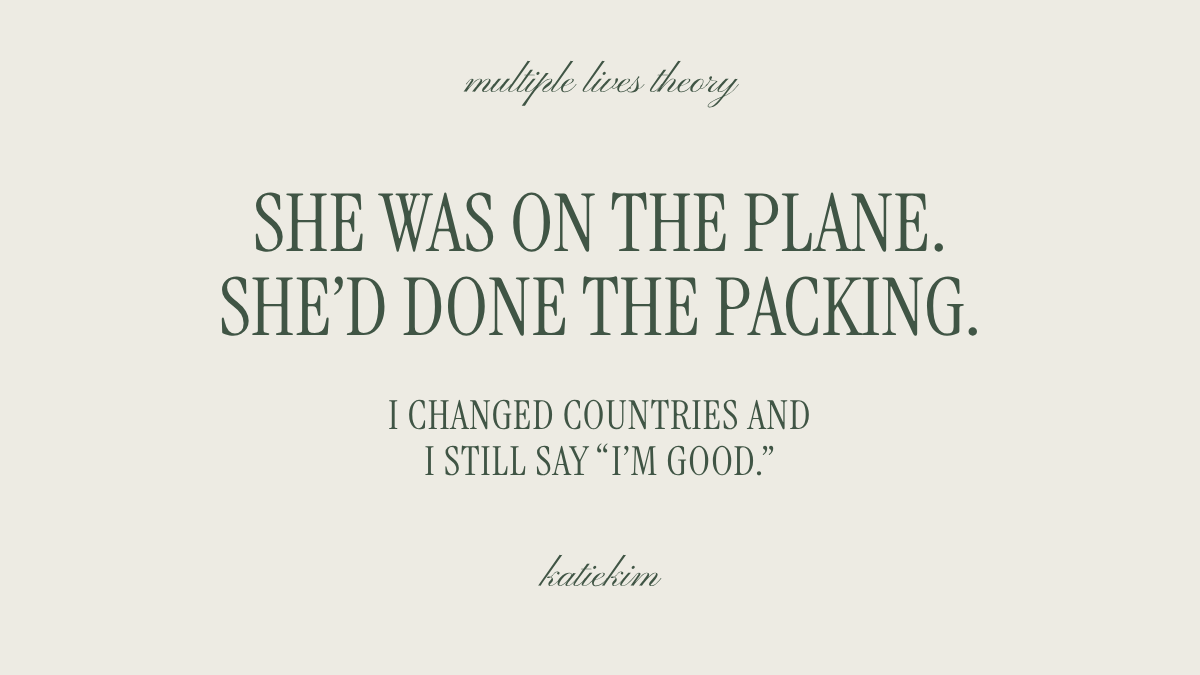
She was on the plane. She’d done the packing.
Which, now I write it down, is the least surprising part. Packing is working out what everyone will need and making sure nothing causes a problem later. That’s her whole skill set.
What I hadn’t understood is that she didn’t belong to the setting.
She was mine. I think I took her on somewhere in primary school, around the time I worked out that being easy to be around was a reliable way to be wanted, and she’s been very good at her job ever since.
You don’t make someone like that redundant by moving countries. You just relocate her. She arrives a bit jet-lagged and starts looking for a room to read.
If anything, she’s louder here than she was in Sydney. Keeping harmony. Keeping up with the expectations around her. In a place where I don’t fully know the rules yet, she has more to do than ever.
I moved partly for more room, and the version of me I most expected to leave behind has found plenty to do in it.
She isn’t the only one who came. I wrote a couple of weeks ago about the career-builder, the one who still wants the next thing and someone to notice she finished the last one. She’s here too. The peace-keeper is just the one I didn’t see coming.
I changed countries and I still say “I’m good” before I’ve checked whether I am.
For a while after I left corporate, I kept asking myself who I am now.
It never got me very far. I think it’s the wrong size of question.
It’s too big to answer, and it assumes there’s one self in there to find if I think hard enough.
The question that has helped is smaller: which version of me is doing this?
The peace-keeper is hard to catch because she arrives before I’ve decided anything. She’s usually already agreed to something by the time I notice she’s in the room. She doesn’t show up as a thought I can look at. She shows up as the obvious next move, already half done.
I want to say something in her defence, because there’s a version of this essay that treats her as a fault to fix, and I don’t think that’s right.
She’s why I’m good at client work. She notices what someone actually means as opposed to what they said, and that’s most of the job. She’s just been running for a long time without anyone checking her settings, and the settings were chosen by a kid who had very different problems.
The only practical thing that has helped is a sorting exercise. It’s smaller than I’d like, but it has done more than anything else I’ve tried.
Two lists. What actually changed when I moved, and what only looked like it changed because the setting did.
What changed: the commute, the meetings, the Sunday evening dread, how much room there is in a week, how many people are holding an old picture of me. Those are real, and they’re gone.
What only looked like it changed: the peace-keeping, the habit of agreeing before I’ve decided, and the version of my tone that sounds fine to everyone, including me.
I didn’t leave a corporate job to work on my instinct to keep the peace. I left for the room.
The room is what made the rest of it visible, which I wouldn’t have put on any plan, and I wouldn’t give it back.
The first list is what the move bought. The second is what it showed me. If someone made me be honest, I think the second list is the one I was actually paying for.
If you’ve moved, or left a job, or changed something big, it might be worth making both lists. The first one is usually easy. The second takes longer, and it tends to be the more interesting one.
Which version of you did you assume you were leaving behind?
Read next
The Multiple Lives Library is where the tools live.
✍️ New here?
Multiple Lives Theory is for people in the in-between, when the life you’ve built no longer quite fits, but the next one hasn’t taken shape yet.
A new free essay lands every Sunday.
Paid members get The Multiple Lives Library, a growing collection of decision maps, workbooks, Notion dashboards, and practical frameworks for figuring out what you actually want and experimenting with what comes next.
The essays are where we make sense of the questions. The Library is where we start turning them into experiments.
I think this is one of the things I’m discovering too, Katie.
I changed countries, left behind a life that looked perfectly sensible on paper, and started building something very different. But apparently, the version of me who spent years following the rules, being responsible and worrying about doing everything ‘right’ came along for the ride. 😅
I particularly liked your distinction between what actually changed and what only looked different because the setting changed.
I don’t think I expected moving to magically turn me into someone else, but I hadn’t quite anticipated how much of the old programming would still be there.
And maybe that’s the interesting part. Having enough room in your new life to finally notice it, rather than just carrying on as before. 🌿
Your two lists are really interesting and remind me of something I've explored in therapy around the behaviours which are easy to change (learnt in adulthood) and the ones which we think are intrinsic parts of us but are really just learnt in childhood (and much harder to change). Loved reading this piece