


Hi, I’m Katie. Multiple Lives Theory is about the identity side of changing careers, written from inside the change. A new free essay lands every Sunday.
The short version: for a long time I thought I needed a resolved answer to “what do you do”. One neat title.
Now I introduce myself as someone still in progress. It’s the most honest answer I’ve given, and people seem to meet it with curiosity more than judgement.
One neat title
In Sydney I felt a lot of pressure to fit into a box.
One neat title, something people could repeat back to me. I’ve wondered a lot about where that pressure came from. It might have been the usual expectations, or wanting everyone around me to understand me, or something internal inside me.
For a long time I believed I had to show my whole true self to everyone. Friends, colleagues, my parents, distant cousins. If I was going to be understood, it had to be the same version for all of them, and it had to fit in a sentence.
The title did a lot of work for me back then.
The stable pay, the impressive tech title, the two small businesses on the side, the house, the full calendar. I used all of it as evidence that I was doing well. One neat title was the shortest way to show that evidence to someone I’d just met.
So for a long time, that meant answering “what do you do” with the job I’d left. My Substack bio started that way too.
Ex front-end dev. It was accurate, and it was the easiest thing to say.
I’m not the only one. In the comments on older essays, people kept answering in the past tense. I was at a big tech company for eight years. I used to teach. I was in marketing-tech.
I recognised myself in every one of those comments. Each of them was true, and each of them was about someone who wasn’t quite there anymore.
None of those people were hiding anything. The past tense was just the answer with the fewest follow-up questions.
The old job is the last answer anyone agreed on. It’s resolved, and that’s what makes it feel safe.
It also has a cost, and it took me a while to see it. When you introduce yourself with the job you left, the conversation goes there. People ask about the old company, the old industry, whether you miss it. You end up spending the start of meeting someone new talking about a life you’ve already stepped out of.
Nobody is doing anything wrong in that conversation. They’re responding to what you gave them.
I think this gets harder in the in-between. When you’re no longer who you were, but you don’t know yet who you’re becoming, both of the easy answers are sitting right there. The past tense is safe because it’s finished. The future tense is safe because it hasn’t happened, so nobody can check it.
The present tense is the uncomfortable one. It asks you to describe a life that’s still being arranged, out loud, to someone who might not get it. No wonder so many of us skip it.
Here in Japan
Here in Japan my answer is longer, and it isn’t resolved at all.
Living here, without a lot of my usual defaults, has made that easier. Nobody here knows the old title, so it can’t do the work for me. I have to describe what I’m actually doing now, and that turns out to be a longer, looser list than the one I used to give.
I live as a digital nomad and work on a few things: designing for the web, consultancy, writing and teaching English remotely.
People nod. Then they either move on or ask about one of them.
All that effort in Sydney to be understood, and most people only needed a nod. Some of them wanted to hear more.
I’ve been working on how I introduce myself here, moving away from the professional pitch I used to give and towards something that invites an actual conversation. The pitch was built to be impressive. This version is built to be answered.
Somewhere along the way I stopped needing everyone to get it. I no longer feel the need to explain myself, even if I’m misunderstood. That’s been a new layer of confidence since moving, and I didn’t expect it to arrive through something as small as an introduction.
It helps to remember that no one is really thinking about you as much as you think they are. Most people hear your answer, place you somewhere roughly right, and get on with their day. That used to sound a bit bleak to me. Now it feels like a lot of freedom.
A fluid identity

I’ve started thinking of this as a fluid identity, and the idea comes straight from my work.
In web design, a fluid layout stretches to fit whatever screen it’s on. It still has structure. It just doesn’t insist on one fixed width.
I think identity can work like that. The content stays the same: what I care about, how I work, what I’m curious about. The layout shifts with the room, the season and the year.
It also explains something I used to find confusing, which is that I come across slightly differently depending on who I’m with. I used to think that meant one of the versions was fake. Now I think you can bring different versions of yourself to different people, the same way a site looks different on a phone and a laptop. It’s the same site.
There’s another idea from responsive design I keep coming back to, which is the breakpoint. A breakpoint is the point where the screen changes enough that the layout has to rearrange itself. The columns stack differently, some things move up, some things get tucked away for a while. Nothing is deleted. It’s the same content, arranged for a different width.
Leaving my last full-time role was a breakpoint. Moving to Japan was another one. Each time, the layout of my life rearranged, and each time I felt the urge to explain the new arrangement as if it needed defending. In design, you plan for breakpoints in advance. In life, they mostly happen first, and you work out the new layout afterwards.
Looking at it now, a lot of the content made it through both. I’m still interested in how people interact with technology. I still care about making websites that are accessible and easy to use. I’m still curious about language, which is probably why I ended up teaching it and learning it at the same time. The order and the proportions changed. The things I care about didn’t.
I used to think an unresolved answer would make me sound unsure. In practice, I’ve noticed it does three things.
It’s true. I’m not performing a finished version of myself that doesn’t exist yet.
I did a lot of performing in my old life. On paper it looked finished, and some days it felt like being a walking shell. An unresolved answer is a small way of not doing that anymore.
It invites a question instead of a verdict. A neat title gets filed away. An open answer gets asked about.
It leaves room. If next year looks different, nobody needs to be told the old answer was wrong. It was only ever the current one.
I wrote last week about release notes, the short updates software teams publish when something changes. An introduction works a bit like the latest release. It describes this version. Nobody expects it to describe every version that came before, or every one that’s coming.
The present tense
None of this means having no answer.
Answering in the present tense is still a kind of ownership.
The past tense is evidence. It tells people who you were. The future tense is speculation, “I’m hoping to” or “eventually I’d like to”, and it quietly hands your story to whoever is listening. It often invites advice about how to get there, whether you asked for it or not.
The present tense, even an unresolved one, is yours. It’s simply what’s true this month, and nobody has to approve it.
Something I’ve learned from Japan is that every decision doesn’t have to be final. It’s the small micro decisions that add up. A present tense introduction fits that. It doesn’t commit you to a life. It just says where the stitching is up to today.
I’ve been leaning into what I think of as a CEO mindset lately. Taking charge of my own time, replying to messages on my own schedule, deciding what my week is for. The present tense introduction feels like part of the same thing. I’m not waiting for someone else to confirm what I am before I say it.
Saying mine out loud has helped me step into the life I’m designing. I don’t need the final version to start living this one.
An unresolved introduction
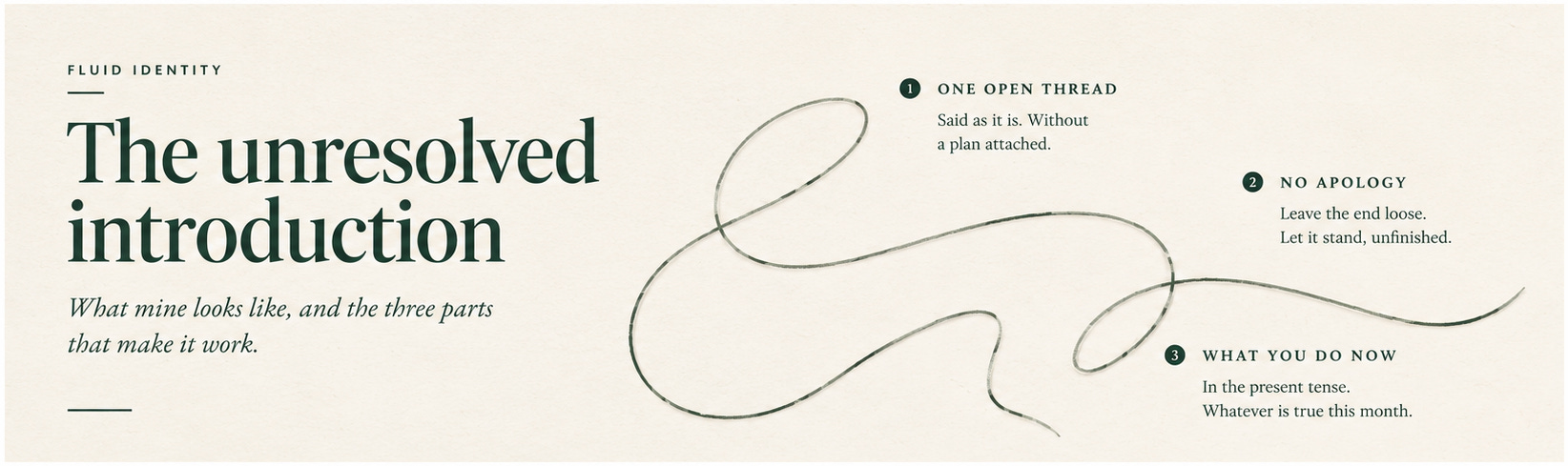
If you’d like to try an unresolved introduction, it has three parts.
What you’re doing now, in the present tense.
One thread you’re still exploring, said as it is. Something like “and I’m finding out what that turns into.”
No apology on the end.
If three parts feels like a lot, start with the first one. Just the present tense, said plainly, is already a change for most of us.
And it doesn’t have to be the same every time. You can give a longer version to someone who seems curious and a shorter one to someone who doesn’t. The content stays the same. The layout fits the room.
Mine, on a good day, sounds something like this. I live as a digital nomad, I design websites and do some consultancy, I write and I teach English. And I’m finding out what that turns into.
It doesn’t need to be clever. It needs to be true this month.
Try it the next time someone asks. Notice what the other person does with it. Mostly, in my experience, they nod and carry on, or they ask about the thread.
Then notice what you do with it. That’s the part I’d pay attention to.
If you’re somewhere between who you were and who you’re becoming, I think the present tense is worth practising, even clumsily. It’s one of the few places where you get to decide how your story is told while it’s still being written. The past already has its version. The future can wait.
Paid members, last week’s essay, You’re Going to Disappoint Someone, has my release notes for the people who push back.
Still a fluid version
I’ve changed my bio a little since. It’s still a fluid version.
I’ve been wondering what it would look like unresolved on purpose. A few threads, still being stitched.
If you try your unresolved introduction, I’d love to read it in the comments.
Explore more
The Multiple Lives Library is where the tools live.

Holy crap Katie!
Finally, you're starting to see. There is no final version; there is no one version that is more right than the other, there is no version that was wrong to begin with. We're in constant flux, always being versions of ourselves dependent on who we are with, where we are, how we feel, what mood we're in, what's happened to us in our lives, what kind of clothes we're wearing or whether we feel excited or sad.
Every version is still you, there is not one that is more correct than the other. There are those that feel better and are more comfortable perhaps? While others might feel forced or performed. I like to describe them as clothes that you wear. The body underneath remains the same: it's the same heart, same soul, same mind, same skin; it’s the jacket choice and shoes that push us towards a version. Formal with black shoes feels very different to puffy windbreaker and sneakers.
So, I like exactly what you've been saying. It made a lot of sense, particularly the use of the word fluidity. I still think that using the term “unresolved” invites a bit of ambiguity. While it can mean “I’m in the process of resolving it” it can also imply, in my mind at least, “I don't know” and that, potentially, presents as lack of confidence or uncertainty. So, I'm not sure if unresolved is the best word - for me at least - but I understand what you mean by it.
I prefer the term fluid. It is forever changing, it can be anything, can go back and forth and still be the same thing. It changes shape to suit the container it is in and can even fit back into the container it originated from. The fluid itself never changes barring its volume. Growth by definition denotes a change in size and not necessarily substance. There may be more fluid than can fit into previous containers, but that does not limit you from “leaving a bit of it out” for you to collect upon your return to the bigger container you were in before. Like the mimetic polyalloy T-1000 in Terminator 2, you can leave a piece of yourself behind on the side of the road, and pick it up later, absorbing it back into the whole again. You can even still be the old version of yourself in certain situations. There is no governing body that is judging you for becoming your old self for any given reason at any given moment. Much like you pointed out, most people don't actually give a shit as much as you think they do.
Here's a thought experiment for you. Go back to your early primary school days. Think hard and long about those days. Find a memory; a memory that reminds you of a version of yourself that you are now or have been recently. I would say that the five or six year old version of Katie - at her core - was still very much the same as the one that currently resides in you right now.
So, bravo, I believe you finally let go of finding the ultimate version of Katie, because as far as I can see, the Katie that I met three or four months ago is still the same heart, mind, and soul: the ultimate version that is forever evolving. Much growth has occurred, that is evident.
It's time, skill, mood, knowledge, situation, circumstance and a million other variables, that slightly alter what version you feel inside. The version is YOUR perception. What everyone else sees is just Katie. 👊🏻👽
The three-part structure is the useful bit: present tense, one open thread, no apology on the end. Most people get the first part right and then undercut it by apologising for the thread not being finished yet.
The CEO mindset line is the real unlock though. Waiting for someone else to approve your answer before you're willing to say it out loud is borrowed authority, and most of us don't notice we're doing it until we stop.