


Hi, I’m Katie. Welcome to Multiple Lives Theory (MLT).
MLT is about unlived lives, identity, reinvention, and the question: how many lives can we live within this lifetime?
These essays go a little deeper: exploring the ideas, questions and practical ways of thinking that can help us build lives with more room for who we are, and who we might become.
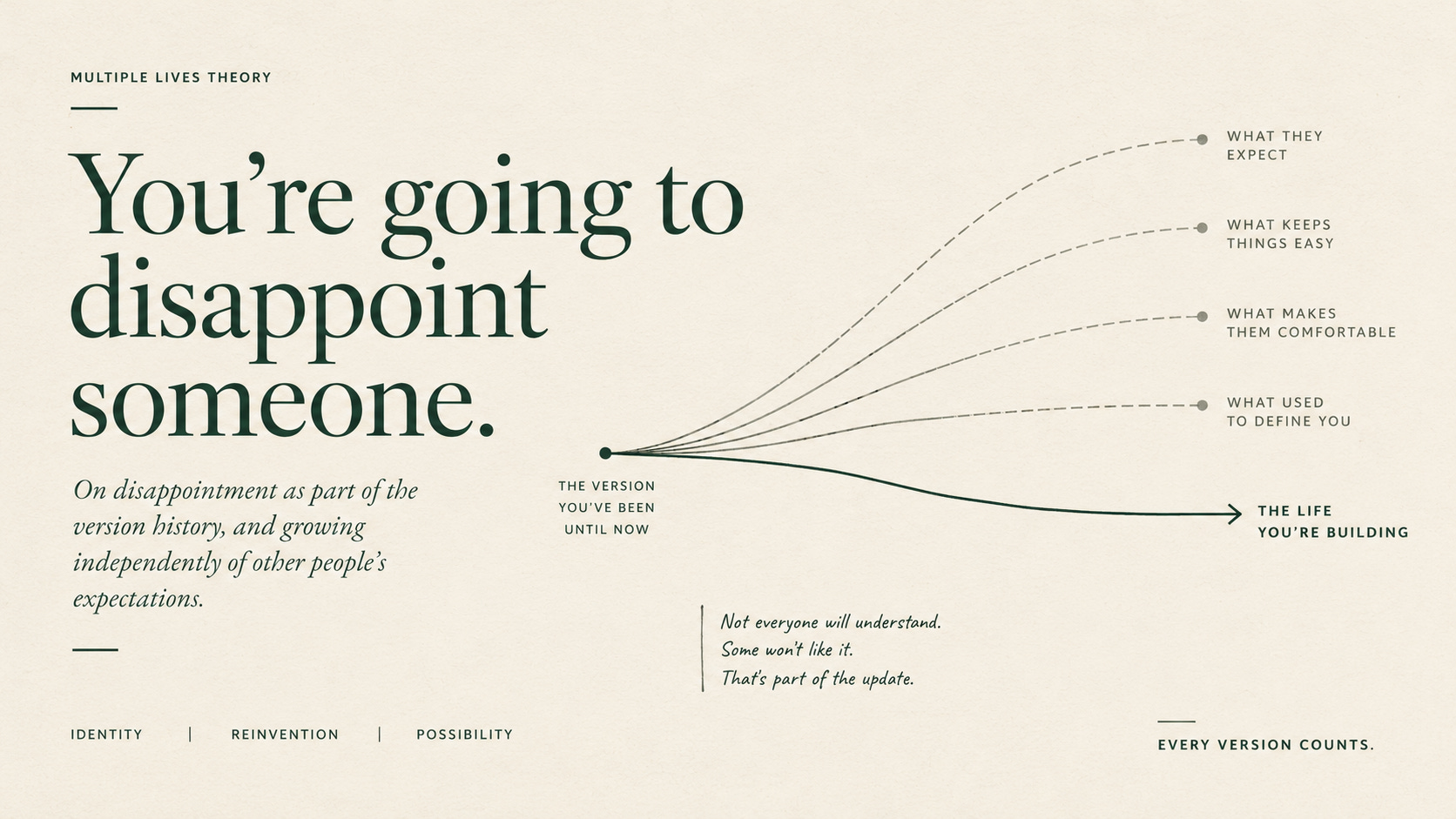
In Sydney, “what do you do?” felt like a test I had to pass in one line.
I felt a lot of pressure to fit into a box. One neat title, something people could repeat back to me.
I still don’t know where that pressure came from.
Part of it was probably the usual expectations. Part of it was wanting everyone around me to understand me. And part of it, I think…no I believe it was me.
Here my answer is longer.
I say I live as a digital nomad and work on a few things: designing for the web, consultancy, writing and teaching English remotely.
People nod and smile, get excited for me. Then they either move on or ask about one of them.
All that effort to be understood, and the thing most people needed was a nod.
Who we think we’re disappointing
Other people’s reactions come up in the comments here more than almost anything else.
Someone close asking “are you sure?” Someone else asking “this is just for a year, right?”
One reader said she uses the one-year line herself, about her own leap, because it’s easier for everyone to hear, while privately hoping it lasts much longer.
Another described rehearsing a defence of her choices for conversations that never actually happened.
I recognised that straight away.
I wrote a few weeks ago about the part of me that keeps the peace, the one who reads the room before she reads herself and says “I’m good” before checking whether I am. She’s very good at rehearsing answers to questions nobody has asked yet.
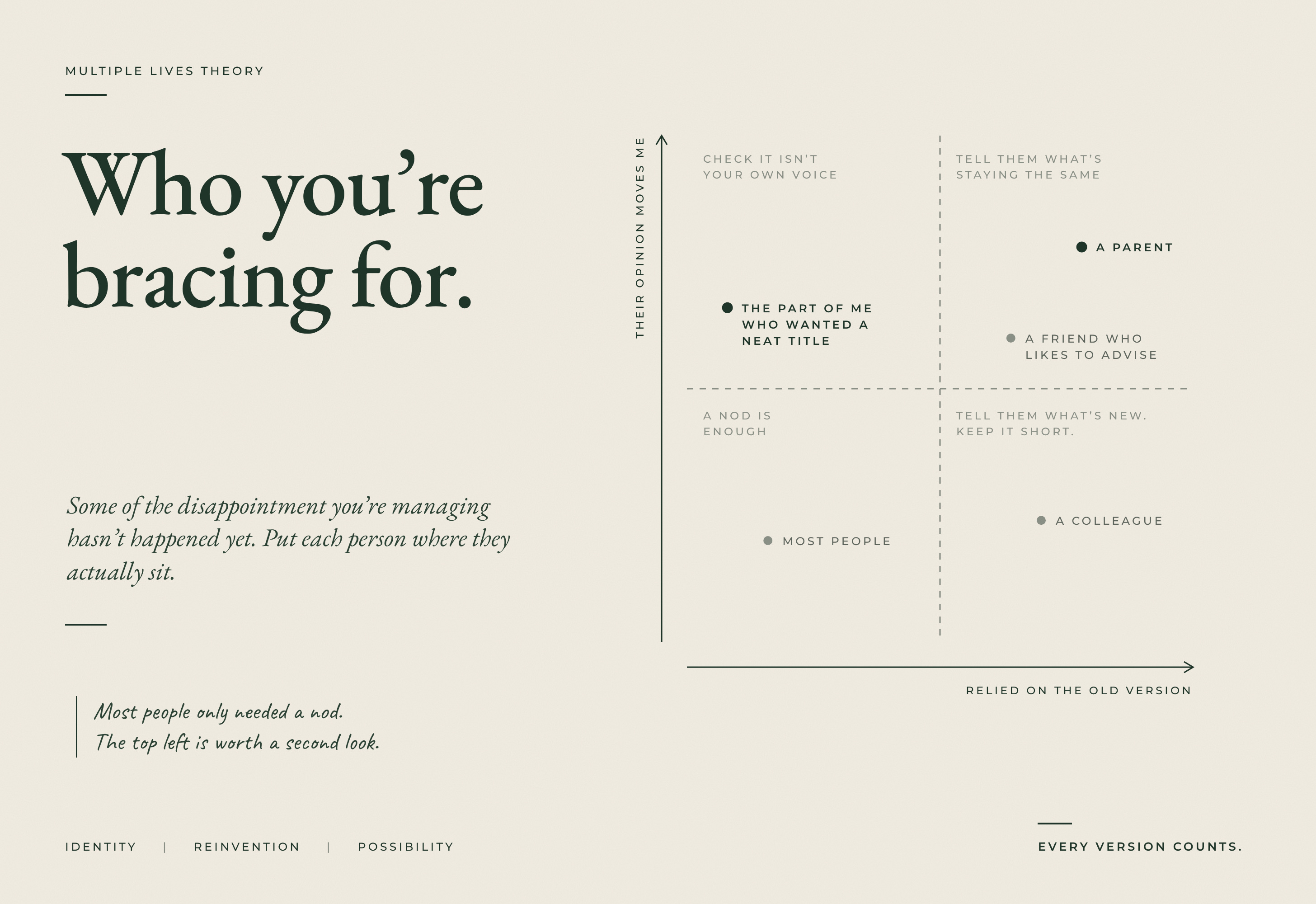
If you have a version of her, you know the problem already. A lot of the disappointment we’re managing hasn’t happened.
We’re managing a forecast.
Some of it will happen anyway
I want to be fair to the other half of this. Some people will be disappointed and it won’t be imaginary.
If you change something big, someone who liked the old arrangement loses something.
A parent loses a simple story they could tell about you.
A colleague loses the person who always picked up the extra work.
A friend loses the dynamic they were used to.
So I’ve stopped asking how to avoid it.
Instead, I’ve started looking at it the way I’d look at a product update.
Yes, I know a life isn’t a product. It’s just the frame that makes the most sense to me, so bear with me.
What an update feels like
I build websites, and anything on the web lives through versions.
In software there’s a name for an update that stops something working the way people were used to. It’s called a breaking change.
Good teams don’t avoid breaking changes forever.
If they did, nothing would ever improve. They plan for them, they’re clear about what’s changing, and they keep the important things working.
I think a career change, or any shift in who you are, works a lot like that. The people who relied on the old version feel it first.
Their disappointment is what an update feels like from the outside.
It’s also a sign the change is real.
Why we over-explain
I’ve written before about over-explaining and I frankly, I still catch myself doing it.
Almost every extra sentence is an attempt to get ahead of a judgement nobody has made yet. It’s trying to prove the change is allowed.
A long explanation turns an update into a request.
You end up asking for approval on a version of your life that was never theirs to approve.
Hence why, release notes are short for a reason.
Identity independence
The part that took me longest to see is that I’m not one product with one version number.
The studio is on one version.
The consultancy is on another.
The writing, the teaching, my Japanese immersive learning and my marathon training are all somewhere different, and most of them are still unresolved.
When I look back at it, it feels like a mess I needed to tidy before anyone saw it.
Now it feels more like the point.
A life with several facets is always going to have some of them mid-update.
Identity independence - the way I think about it, means you stop waiting for everyone’s sign-off before each new version.
You can stay close to people, keep the things they rely on, and still evolve without their permission.
Some of it will disappoint someone. That’s part of the version history, and every version you’ve ever been is still in there.
Write your release notes
Pick one change you’re making, or thinking about making, this year. Then write five short sections about it. It takes about twenty minutes.
What’s new. One line, in the present tense, saying what’s actually happening. Leave the apology off.
What’s staying the same. The things people relied on that you’re keeping. A weekly call, the way you show up for a friend, the work you’re still glad to do. In software this is called staying backwards compatible.
What’s being retired. The old expectation you’re no longer going to meet. One plain sentence is enough.
Known issues. What’s still unresolved: how long you’ll stay, whether it’ll pay, what comes next. Naming these yourself takes a lot of the power out of other people pointing at them.
Who needs to read them. The actual people, by name. Most of them only need the first line. A few need the second. Very few need all five.
Then read them out loud. If they start to sound like a request, cut back to the first line.
Release notes won’t stop everyone being disappointed. They just mean you’re not asking permission for the update.
Here are mine, from these last couple of months abroad.
What’s new
I’m travelling and living abroad for a couple of months at a time, meeting people I’d never have met at home, and it’s let certain parts of me come out and breathe.
One of them is teaching English.
I taught as a side gig in my early twenties, and it opened my eyes to other cultures, to how our brains work, and to the patterns in how we think and relate to each other.
I’ve picked it back up. This time the decision feels liberating.
Before, I’d have made it from survival, or to impress someone.
I’m also leaning into a CEO mindset, which is a big change for me, even after running three businesses. I get to take charge of my own time.
I reply to messages and emails when I can, and I don’t have to explain that to anyone. I used to feel bad about all of it, convinced people were sitting there thinking about me and waiting.
Honestly, no one is really thinking about you. I’m embracing that now.
What’s staying the same
The dynamics I’ve built with people. I’ve realised you’re allowed to bring different versions of yourself to different people.
Years ago I couldn’t sit well with that. Whether it was a friend, a colleague, my parents or a distant cousin, I felt I had to show every one of them my whole true self. Now I think those versions adjust along the way, through the conversations that build each relationship.
What’s being retired
The rest of this essay is for paid members. It’s where I share my own five notes from these last couple of months abroad, and if you’d like to write yours alongside mine, it’s less than a coffee a week.
