


Hi, I’m Katie. Welcome to Multiple Lives Theory, a place for anyone who has ever wondered: “How many lives can I live within this lifetime?”
I write about unlived lives, identity, reinvention, and what happens when the life you’ve built no longer quite fits. I’m writing from Japan at the moment, living as a digital nomad. A new essay lands every Sunday.
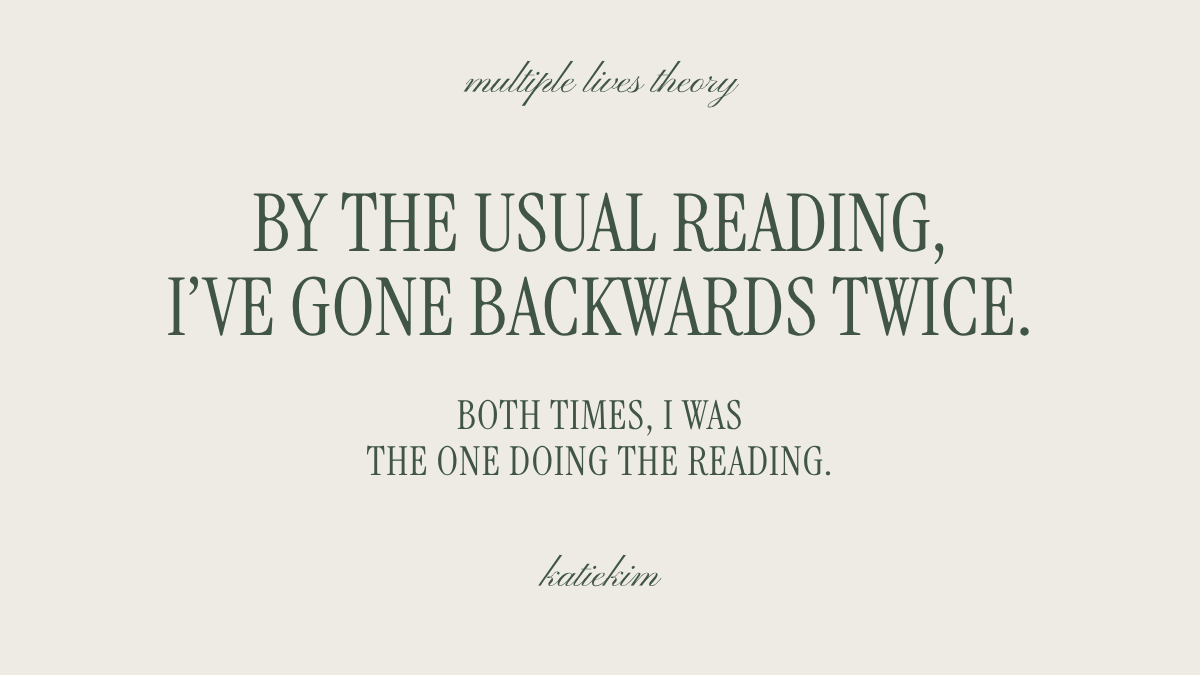
The short version: going back to something you left can be a retreat or a return. From the outside they look the same. The difference, as far as I can tell, is whether you can say what you’re going back for.
By the usual reading, I’ve gone backwards twice in my working life. Both times I was the one doing the reading.
The first was leaving the lab. I had a chemistry degree and went into web development, because the lab work didn’t pay, and for about a year I described that to people as a detour.
The second was going back into corporate.
I’d been running my own businesses alongside my web development work, and then I took a role at a big global company. It felt like walking back through a door I’d made a bit of a point of walking out of.
What I remember most is the pre-emptive work. Rehearsing how I’d explain the move if anyone asked. Having a version ready that made it sound strategic, which it partly was, and confident, which it wasn’t. Most people were just curious about what was next for me. I don’t think I ever needed the speech.
These days it’s old colleagues who ask, and the question is usually “have you found a job yet?” It’s a fair question from where they’re standing. In their picture, what I’m doing now is the gap between two jobs.
I think what I was doing back then was measuring the direction of a move instead of what was in it. A career is supposed to point one way. Anything that points back gets called a retreat, whatever is actually inside it.
The distinction I didn’t have then is between a retreat and a return. From the outside they look identical, so I’m not sure anyone can really tell which one somebody else is doing.
A retreat is going back because the new thing got hard and the old thing would still have me. Nothing has changed in between. I’d be the same person walking back into the same room, hoping it holds the way it used to.
A return is going back for something specific, or carrying something I didn’t have before.
I went back into corporate for the money and the global roles.
That’s a less noble reason than I’d like, but it was a real one and I knew what I was getting. Those years paid for a lot of what I’m doing now. I spent a long time apologising for them anyway.
Going back for something also seems to make you harder to absorb. When I knew what I was there for, it changed what I agreed to, what got to me, and how much of myself I handed over.
If I can say what I’m going back for, it’s probably a return. If all I can say is that this is hard, I’m less sure.
The test I use, such as it is, is whether I can finish one sentence:
I’m going back for ______, for about ______ long.
A return usually fills both blanks with something specific.
Back for the money, for two years, to clear something. Back to a city because family is there and that matters more than I was admitting. Back into a field because I liked the work and only left because of one manager.
A retreat tends to fill the first blank with a mood. Because this is hard. Because it was easier. Because everyone else seems settled.
On the day, the two feel the same, which is the unhelpful part. But a mood has trouble with “what for?”, and something specific usually doesn’t.
I tried it on myself, because I’m always circling back to the idea of a 9-5.
When I fill in the blank honestly, what comes out is comfort, and the norm. Building something in public gets lonely, and it isn’t what most people in my circle are doing, so a regular job starts to look like a way back in.
I wrote about that pull last week, and I think this is the other half of it. By my own test that’s closer to a mood. I’m not completely sure it stays one.
I don’t want this to bless every reversal. Some going back really is going backwards. I’ve done that too, more than once, at a smaller scale, and told myself a good story about what I was going back for.
The other side worries me more, though. People who can’t go back for the thing they actually want because the arrow doesn’t allow it. So they keep going the right way, quietly wanting something behind them.
I’m learning Japanese now. I nearly enrolled in it at twenty and chose more science instead.
I’m picking it up more than a decade later, in the country, much more slowly than I would have then, and around work I didn’t have then.
The version of me who nearly did it at twenty would have been faster and had more time.
She’d also have been doing it for reasons that have since expired. I’m slower, and my reasons are still live.
Most days I think that’s the better trade. On the days I’m trying to read a form, I don’t.
By the arrow, that’s a long detour that ended up back where it started.
I can’t make myself mind about the arrow anymore. I think that’s either the whole point or the start of a longer argument I haven’t finished having.
If you’re weighing up going back to something, whether it’s a job, a city, a field or an old plan, try the sentence. You don’t have to show anyone what you wrote.
What would you go back for, if you could name it?
Read next
The Multiple Lives Library is where the tools live.
✍️ New here?
🍀 Multiple Lives Theory is for people in the in-between, when the life you’ve built no longer quite fits, but the next one hasn’t taken shape yet.
A new free essay lands every Sunday.
Paid members get The Multiple Lives Library, a growing collection of decision maps, workbooks, digital artefacts, Notion dashboards, and practical frameworks for figuring out what you actually want and experimenting with what comes next.
The essays are where we make sense of the questions. The Library is where we start turning them into experiments.