


Hi, I’m Katie. Welcome to Multiple Lives Theory — a place for anyone who has ever wondered: “How many lives can I live within this lifetime?”
I write about unlived lives, identity, reinvention, and what happens when the life you’ve built no longer quite fits.
Essays from inside the transition, every week.
A quieter one today, about the sentence I hand people at parties instead of the actual years.
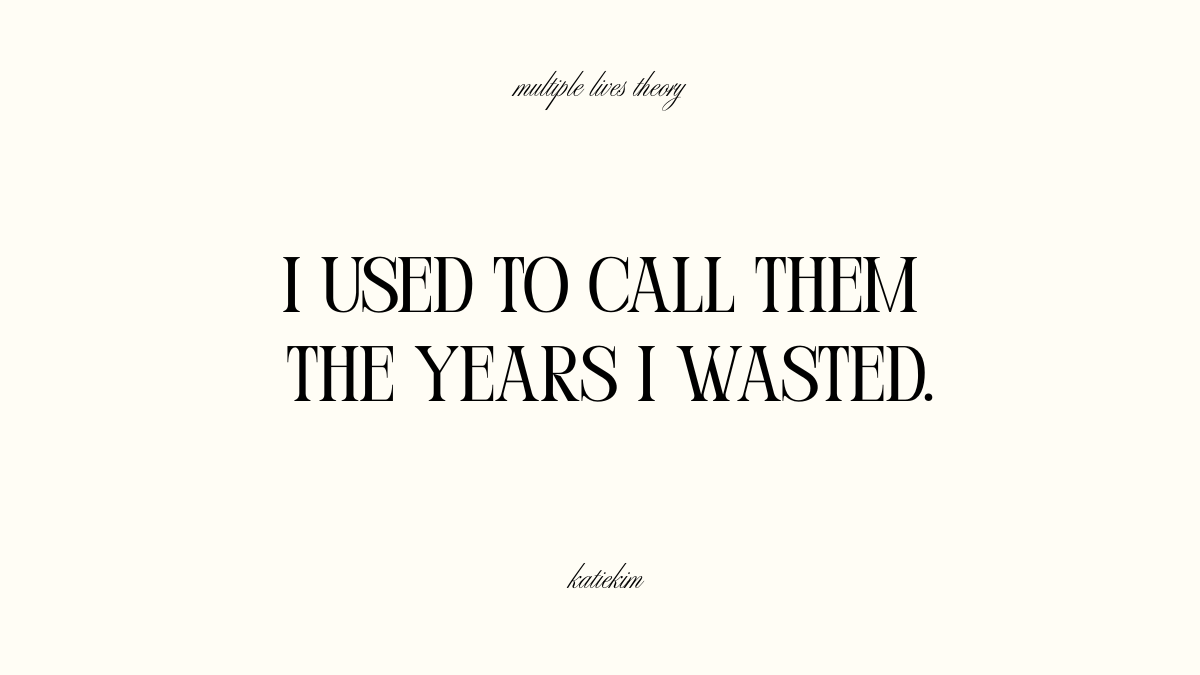
At parties, at networking things, at birthday dinners, I’ve got it down to one line.
The shift out of medical research, the hustle years in tech, the businesses I built after the 9 to 5, all of it folded into a single sentence, delivered with a smile, and then, before anyone has a chance to actually respond to it, I add but I’m doing okay, just in case the sentence on its own sounded like it needed rescuing.
I’ve said some version of that line often enough that I don’t really hear myself say it anymore, which is probably the actual problem, if I’m honest, more than anything about the years themselves.
What would actually happen if I let the sentence run long at an actual party?
There are two stretches I do this to most.
The first is the run of months between roles when I’d tell people I was “taking some time to figure out next steps.”
What I was actually doing was hunting for the next business idea instead of resting, picking up ghostwriting and copywriting outside my own field because it paid.
And at one point landing a six-month contract at a health and wellness startup in Australia that never fit, in a role where part of the commute was a ferry…
The second is the years I spent chasing titles and a six-figure salary because I wanted to feel seen. I got both, eventually, and neither one did what I was expecting it to do.
Both of them get the same treatment. A clause each, if that, and then I move on before anyone can ask a second question.
Making the tidy version
I don’t think I’m lying, exactly, when I compress it like that. Everything in the one line is true.
But compression isn’t neutral, and I think that’s the part that took me a while to notice.
Every time I shrink those years into a sentence I’m also choosing, without quite deciding to, what gets left standing and what gets cut, and what gets cut tends to be the same things every time, the actual weight of it, the parts that would take longer than a party allows.
What would the room actually do with the real weight of it, if I handed it over instead?
I do it, I think, because the tidy version is easier to hand to somebody who asked a casual question and is expecting a casual answer.
Nobody at a birthday dinner wants the long version, or so I’ve assumed, maybe wrongly, and the smile at the end is doing a specific job too.
It’s telling the room the sentence is over and everyone can relax now, including me.
What gets cut is always the useful part
The gig-hopping years built a specific kind of adaptability.
I got fast at walking into a role I hadn’t fully vetted and finding the one useful thing to take from it before I left, a habit I still use now, of looking at whatever’s actually in front of me and asking what could be improved instead of waiting for the ideal setup.
The title-chasing years built less of a skill and more of a fact I needed to learn about myself the expensive way: that a bigger title doesn’t quiet the part of me that’s still asking what’s next.
I don’t think I’d believe that if I hadn’t spent a few years proving it firsthand.
Neither of those fits in a clause, which is exactly why neither of them makes it into the sentence. The tidy version keeps the timeline and throws away the evidence.
Would either of those sound like an achievement if I said it out loud instead of folding it into one line?
But I’m doing okay
That line, the one I tack on at the end, is maybe the part I’d most like to look at honestly.
It’s not untrue, I generally am doing okay, but I notice I say it fast, before anyone can ask a follow-up, which suggests it’s less a statement of fact and more a way of closing a door I don’t actually want opened at a party.
Somebody did once ask me about one of those years directly, and it went differently to how I expected.
It was an interviewer at a company I eventually joined.
My CV showed the pattern, a role every year and a half or two, and she asked about it the way people usually do, as a vetting question, checking whether I’d actually stay this time.
I told her the true version.
Most of those had been contract roles that ended on schedule, and the ones that weren’t, I’d left because the company had gone repetitive and monotonous, no more room in it, and I was ready for something with more depth.
She didn’t file it as a red flag.
She said she could tell I was ready for something more substantial, and moved to the next question like I’d passed rather than explained myself out of a hole.
I’ve thought about that exchange more than the interview probably warranted, mostly because it was the first time the true version got me a better result than the tidy one would have.
Would the tidy version have gotten the same answer from her, or only the true one did?
I think what I’m actually doing, across all of this, is narrating my own history the way you’d clean the house before someone visits; quickly, instinctively, moving the obviously messy things out of sight rather than actually dealing with any of them.
The years themselves aren’t the detour. The tidying is a habit I picked up somewhere along the way, and I’m not sure when, exactly, it started running automatically.
There is one I’m still slightly embarrassed by, though embarrassed isn’t quite it.
It’s closer to regret.
How long does regret get to run before it’s allowed to just be information instead?
The years I spent taking whatever role paid the most without checking the team, the culture, or what the actual day to day would be like.
I had what I’d call ‘shiny object syndrome’, watching what people around me were doing and adjusting to match rather than trusting my own read on a situation.
One of those decisions put me in that toxic health and wellness contract, the one with the ferry commute. I said yes to it inside a week.
Which is probably its own answer. The compressing was never really about the party. It was about the version of me who used to say yes before she’d actually looked.
I’d like to get better at leaving the sentence open, at some point, at the actual risk of a follow-up question. I haven’t managed it yet, not reliably.
What’s the actual risk, if I let someone ask the second question? Mostly I still hear the smile arrive before I’ve decided to send it.
Which years do you skip or compress at a party, and what words do you use to shrink them?
If this landed, send it to somebody who’s got their own one-line, smile-shaped version of a much longer story.
If this landed, these are the closest:
✍️ New here?
🍀 Multiple Lives Theory is for people in the in-between, when the life you’ve built no longer quite fits, but the next one hasn’t taken shape yet.
A new free essay lands every Sunday.
Paid members get access to The Multiple Lives Library, a growing collection of decision maps, workbooks, digital artefacts, Notion dashboards, and practical frameworks for figuring out what you actually want and experimenting with what comes next.
The essays are where we make sense of the questions. The Library is where we start turning them into experiments.
Written from inside the transition, not the other side.