


Hi, I’m Katie! Welcome to The Multiple Lives Theory. This is a space for anyone rewriting the rules of modern work, embracing a nonlinear career, and actively designing a life of creative freedom outside the standard 9-5 ladder.
You don’t owe anyone the story arc.
A few weeks ago, I caught myself doing something that I thought I would no longer do.
I was at a meetup, talking to someone I’d known for only maybe four minutes.
He asked me what I did for work. Instead of answering the question, I heard myself hesitate and say, “Oh well, it’s a bit of a long story...”
Then I launched into this whole, unnecessary explanation.
The chemistry degree. The career pivot. Why I ended up writing. The reasons behind it all.
He’d asked for a simple job title, probably with no other intention to it other than small talk. Instead, I gave him my origin story.
The funny part is... he never questioned any of it. I didn’t know him. I’ll probably never see him again. Whatever he thought of my answer had absolutely no impact on my life.
And yet I still reached for the version that made my career make sense before anyone had asked me to make it make sense.
I walked away thinking: Why do I keep doing that? Why do I always feel the need to justify and explain myself for even a stranger that will probably have no significant impact on my life?
The audit
After that moment, I immediately took it to my journal and decided to try something. For one week, I paid attention to every time I explained my career to someone. Not the facts. The extra bits. The little disclaimers that crept in before or after the actual answer.
Things like:
“It’s a bit of a long story.”
“I know it sounds random...”
“I’m still figuring it out.”
I didn’t do anything fancy to keep track. I just kept a tally in my OneNote app whenever I caught one. And a few days in, something shifted.
Once I’d started noticing them, I couldn’t stop hearing them. And that’s the point of the exercise. I realised I am not trying to become someone who never over-explains, but trying to catch myself while you’re doing it.
An explanation isn’t the same as an answer
A few days into doing this, I realised I actually had two different ways of answering the exact same question. One sounded like this:
“It’s a bit of an unconventional path. I studied chemistry, then moved into design, and now I write. It probably sounds all over the place...”
The other sounded like this:
“I run a writing business.”
Neither one is more true than the other.
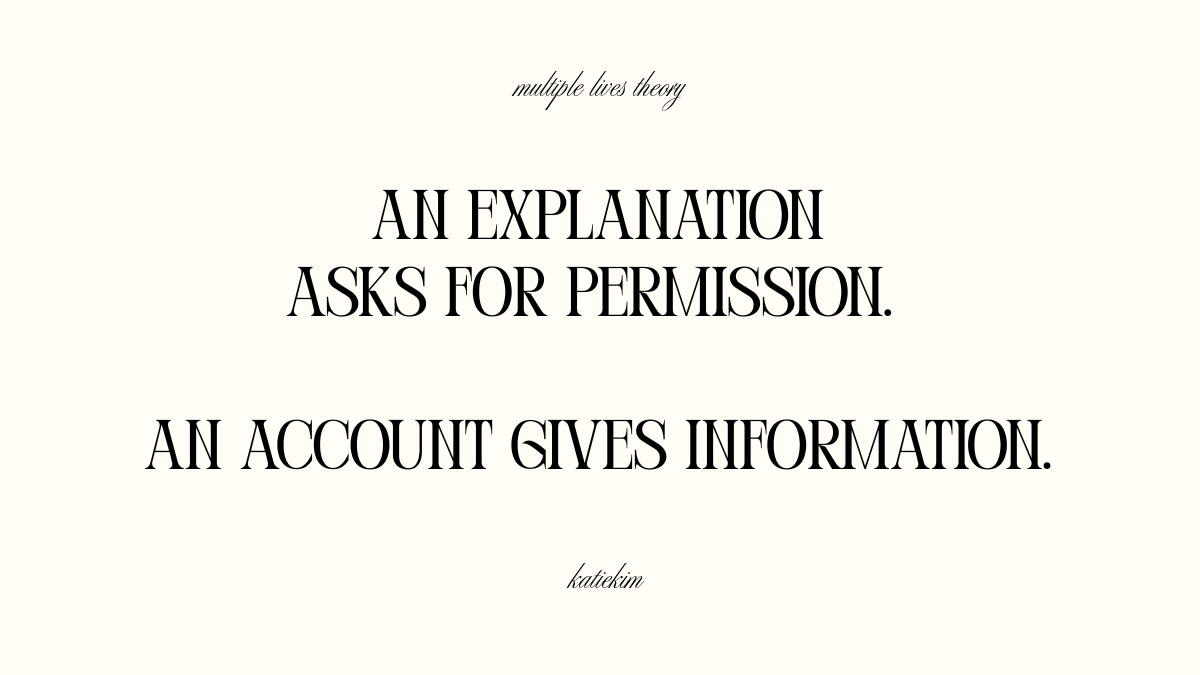
The difference is that one is trying to earn the listener’s understanding. The other is simply answering the question.
I started noticing this everywhere. When I was explaining, I was waiting for the other person to look convinced before I could move on. When I was just answering, the conversation carried on naturally. Sometimes they’d ask another question. Sometimes they wouldn’t.
Either way, I didn’t feel like I’d handed them my life story to evaluate. I think that’s the shift I’m trying to make. Not from honesty to vagueness but from explanation to confidence.
If someone wants to know more, they’ll ask. And if they don’t, they already have enough.
Why we do it
I don’t actually know where this habit comes from. I just know a lot of us seem to experience it and relate.
Maybe it’s because we’ve been taught that careers are supposed to make sense on paper. That there’s a “normal” path, and anything outside of it needs an explanation. So before anyone else has the chance to question it, we do the work for them.
It took me so long to realise this.
The strange thing is, over-explaining doesn’t make us sound more credible. It usually does the opposite. It sounds like we’re trying to convince someone of something they weren’t doubting in the first place.
When I tried to work out where I learned this, I couldn’t land on one answer. Maybe it was years of filling out forms with a single box labelled Occupation. Maybe it was school, where the tidy story always got rewarded. Maybe it was a manager who looked at my CV years ago and asked, “So... what’s the story here?” in a way that made me feel like I owed one. Or maybe it’s sharing with close friends and family and feeling afraid of what they will think.
Nobody sits you down and teaches you to apologise for a career that doesn’t fit neatly into a timeline. You just pick it up somewhere along the way. And once you’ve been doing it long enough, you stop hearing it.
What my own audit found
Before writing this, I tried the exercise on myself for a week. I caught eleven justifying clauses in seven days.
Nine of them were completely unprompted. Nobody looked confused. Nobody challenged me. Nobody even asked a follow-up question. I was answering objections that only existed in my own head, while the other person was probably just waiting for me to finish so we could get back to talking about literally anything else.
The last one was the interesting one. I heard myself start to say, “I know it probably sounds...”
And I stopped. The sentence ended there. Nothing happened.
He nodded, asked what kind of writing I did, and the conversation carried on. That ended up being the whole lesson for me. Most of the judgement I spend time anticipating never actually arrives.
The scripts
So here's what I've started replacing those justifying clauses with.
1. The gap year.
“I took a year out in 2023.” That’s it. Not, “I took a year out because I was burnt out and needed the break.”
The reason is yours. The fact is enough.
2. The industry change.
“I moved from research into design.” I don’t need to follow it with, “I know it sounds like a big leap...”
People usually make the connection themselves. And when they do, it feels like curiosity instead of me trying to convince them.
3. The plural answer.
“I design and I write.”
No need for extra, unnecessary disclaimer about being scattered. No apology for having more than one answer.
4. The still-figuring-it-out.
“I’m building the next thing at the moment.”
That’s true and it’s also enough.
5. The one for family.
“It’s going well.”
Short but simple. I’ve found this one surprisingly useful. Some conversations are looking for connection. Others are looking for an update. I’ve come to terms with it’s okay not to turn every family catch-up into a quarterly business review.
But what if someone actually wants the explanation?
This was the first objection my own brain came up with.
“Sure... but what about interviews?”
Or a client who’s genuinely trying to understand your background. That’s understandably different. The point isn’t to become vague. It’s to stop apologising.
If someone asks about a career gap, I can say:
“I took a year out in 2023 and I missed the work, so I came back.”
Simple and to the point.
I’ve found it’s less about what you say and more about when you say it. Answer the question that was asked.
If they want more, they’ll ask.
You don’t have to answer the follow-up before it exists.
One thing I’ve noticed is that the silence isn’t nearly as uncomfortable as I imagine it’ll be. Half the time, there isn’t another question.
The conversation just... carries on.
The part I’m still practising
I’d love to tell you I’ve stopped doing this but while I am still learning all this, I haven’t.
Last week I caught myself halfway through saying, “I know it probably seems...”
I was on a call with someone I wanted to subconsciously was trying to impress. I heard the words come out of my mouth and immediately thought, there it is again.
The funny thing is, that sentence wasn’t helping either of us. It wasn’t making me sound more trustworthy or making my work clearer.
It was just an old habit showing up. I don’t think this audit fixes that overnight.
What it does do is make the habit visible. And once you can hear yourself doing it, you get the chance to choose differently.
Not every time. But more often than before.
For me, that’s enough.
— Katie
What’s the one line about your career you always over-explain, and what would the full-stop version sound like? Reply with both. I’m collecting the all the honest before-and-afters.
More from Multiple Lives Theory:
→ Your CV is lying about you (it’s designed to): on the format that hides the person
→ The multi-passionate person’s guide to answering “what do you do”: on describing a life that doesn’t fit one title
→ how to explain a nonlinear career without apologizing for it: the earlier version of this argument
→ You don’t pivot. You add.: on why the history never needed defending
New here?
Multiple Lives Theory is a weekly essay on nonlinear careers, reinvention and the emotional reality of changing your life. Free essays, Sundays and Thursdays.

Very raw and vulnerable. Thanks for sharing. I think as we continue building a more indispensable identity of who we are, and realise we don’t need to apologise for our existence, that the need to explain disappears – owning our choices is so important.
I do this a lot as well. For me, I know it stems from my childhood. I also have been actively working on just stating facts and moving on. If someone wants to know more, they will ask.