


The signs were never the point.
I kept a list. Not a literal one — I’m not that organised under pressure — but a mental tally. The manager who dismissed an idea in front of a room. The meeting that existed only to have the meeting. The performance review that was technically accurate and completely missed the point of what I was trying to do.
The Tuesday afternoon I sat in an open-plan office with my headphones in and felt something close to grief.
I had a lot of signs.
Everyone has signs
Most people who’ve been in the wrong job for a while have a lot of signs. The thing is, the signs are almost never the problem. They’re information about the conditions of the job, not about you.
Signs can be improved. A different manager, a restructure, a secondment, a salary review — any of them can resolve a sign. You can wait them out, fix them, report them, or absorb them. Which is exactly why they kept me there so long.
And signs are seductive precisely because each one comes with an action attached — a conversation to request, a case to build, a boundary to hold.
Doing something feels like progress. Mostly it isn’t. It’s motion inside a building you’ve already half-left, and the motion is what convinces you you’re still trying.
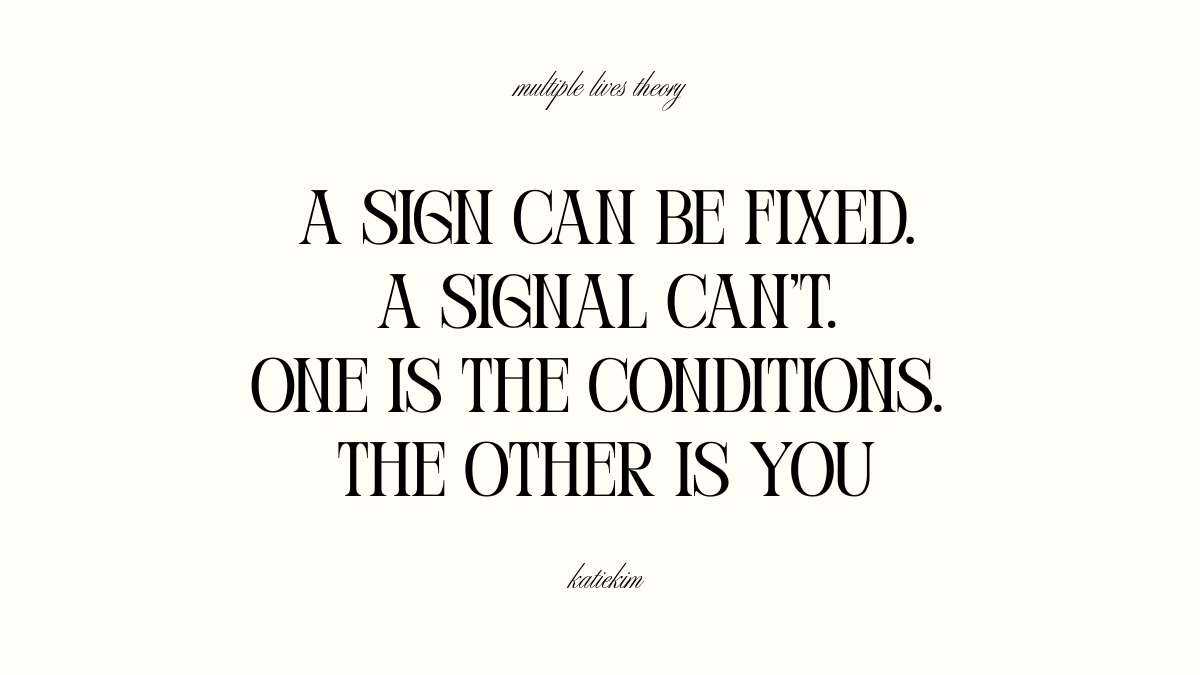
A sign vs a signal
A sign is external and fixable. It happens to you, and it points at the conditions.
A signal is internal and it doesn’t care about the conditions at all.
It’s the moment you stop trying to solve the problem from inside the building — not because you’ve run out of solutions, but because you’ve quietly stopped caring whether they work.
The distinction matters because of what each one does to you:
• Signs always give you something to do — another case to build, another conversation to have — so they keep you busy inside the building for months, sometimes years.
• The signal gives you nothing to do. It just changes the question from “how do I make this better” to “what am I actually doing here.”
• Signs can be fixed. The signal can’t. No restructure reaches it.
When my signal arrived
I can tell you almost exactly when mine came. It was a quarterly review that was, objectively, fine. Good things were said. I got what you’d call a positive outcome. And I sat there feeling — not bored, not angry, not disappointed.
Just completely elsewhere, as if the part of me that used to live in those rooms had filed a change of address and not told me. I took the metro home and thought: I’m not interested in fixing this anymore. Not “I can’t.” Not “I’ve tried.”
Just — the fixing impulse was gone.
I’d had bad days before. Everyone has bad days, and a bad day still argues — it builds a case, it wants the situation to change. This wasn’t that. There was nothing to argue with. The case had simply closed while I wasn’t looking, and what was left wasn’t frustration. It was quiet.
How to tell a signal from a sign
From my own experience, and from the many people I’ve since heard describe their version of it, the signal has a few tells:
1. It’s indifference, not anger. Anger still cares about the outcome. Indifference has stopped.
2. It arrives when you stop arguing. You stop rehearsing what you’d say if given the chance to say it.
3. It’s stable. It doesn’t lift after a holiday or a project change. Mine never did.
4. It changes the question. From “how do I fix this?” to “do I still want this fixed?”
5. It shows up even when nothing’s wrong. Mine arrived in a meeting that went well. That’s the real giveaway — a sign needs a grievance to point at; the signal doesn’t need anything to be wrong at all.
Why naming it matters
I got my signal roughly eight months before I actually left, and those months weren’t wasted — I was saving, building, testing. But I spent a lot of them solving for the wrong variable, renegotiating conditions that were never the real issue. The day I named the signal was the day I stopped spending energy on the building and started spending it on what came next. That reallocation was everything.
I’m not telling you to walk out the moment it lands. Most of us can’t, and rushing it rarely ends well. But there’s a real cost to mistaking a signal for a sign: you keep renegotiating terms that were never the problem, and the months stack up while you do. Naming it doesn’t force your hand. It just stops you solving the wrong equation. I’m still learning to hear it faster, and I’m not sure you can rush that part. But you can at least ask the better question earlier: am I trying to fix the conditions, or have I stopped caring whether they’re fixed? The answer tells you where you actually are.
— Katie
Reply and tell me: was there a specific moment when you knew — not a list of reasons, but a feeling that the door had already closed? I love hearing different perspectives and I read every one.
More from Multiple Lives Theory:
→ the relief you’re not allowed to feel when the job ends — on the feeling nobody prepares you for
→ what happens to your identity when you remove the job title — on who you are when the title goes
✍️ New here?
🍀 Multiple Lives Theory is for people in the in-between, when the life you’ve built no longer quite fits, but the next one hasn’t taken shape yet.
A new free essay lands every Sunday.
Paid members get access to The Multiple Lives Library, a growing collection of decision maps, workbooks, digital artefacts, Notion dashboards, and practical frameworks for figuring out what you actually want and experimenting with what comes next.
The essays are where we make sense of the questions. The Library is where we start turning them into experiments.
Written from inside the transition, not the other side.

This really resonated with me, especially your line: “It’s motion inside a building you’ve already half-left.” Looking back, I spent far too long trying to fix the signs—different projects, new responsibilities, another reorganization—believing the next change would make it feel right again. In hindsight, none of those were the real issue. The harder truth was that I had already outgrown that chapter. Sometimes we’re not looking for a better job within the same building—we’re ready to walk out the front door.
Thank you for articulating this distinction - as someone who just quit my PR job for something less flashy so that I can pursue other things - the signal was after a raise and a promotion. The indifference was impossible to ignore.
I also found this applicable to the moment I knew it was time to leave my marriage three years ago.
A powerful read for me ⚡️