


I spent a long time thinking I had a consistency problem.
I couldn’t keep a streak going for longer than a few weeks. Some people can do the same thing every day for a year. I’ve just never been one of them.
I’d start the habit tracker. Get excited about the new routine. Make it to day 12 or 17 or, if I was feeling particularly disciplined, somewhere in the twenties.
Then I’d miss a day.
And somehow one missed day became evidence that the whole thing wasn’t working.
What I didn’t notice for a long time was that I was actually pretty good at trying things.
Nine of them, on and off, over the two or three years before I eventually left.
Some mornings, I’d sit with tea and a diary before the 9 to 5 started.
Not because it was productive, but because it was the one part of the day nobody else had scheduled.
Some experiments lasted a month.
Some lasted a week.
Some disappeared completely, then came back months later in a different shape.
I cold-messaged business owners for coffee with no pitch prepared.
I tested tools I didn’t understand yet.
I broke things inside free trials on purpose.
I followed ideas that sounded slightly ridiculous when I tried to explain them to someone else.
If I’d tried to track any of this as a habit, I probably would have quit by week three.
But I wasn’t really trying to build habits.
I was collecting evidence.
That distinction changed the way I thought about my life.
A habit tracker asks: Did you do the thing today?
An experiment asks: What did the thing tell you?
Those are very different questions.
A habit tracker treats a missed day as a break in the chain.
An experiment treats it as information.
Maybe I was tired.
Maybe I hated the thing.
Maybe the timing was wrong.
Maybe I liked the idea of it more than I liked actually doing it.
None of those answers is particularly dramatic.
They’re also useful.
And over time, the small pieces of information started adding up.
None of the nine experiments looked like much written down.
Ten minutes with a journal doesn’t look like a career pivot.
One coffee with a stranger doesn’t look like a new professional network.
Breaking a tool during a free trial doesn’t look like the beginning of a different kind of work.
But that was never really the point.
I wasn’t trying to prove, in advance, that any of these things would become my next life.
I was trying to find out what happened when I gave them a little room to exist.
Some things became useful.
Some didn’t.
Some surprised me.
Some confirmed things I already suspected but hadn’t wanted to admit.
And a few kept pulling me back.
That became much more interesting to me than whether I could maintain a perfect streak.
Because when you’re trying to figure out what comes next, I don’t think you always need more discipline.
Sometimes you need more evidence.
You can spend months trying to decide whether you’d like a different kind of work, a different routine, a different creative practice, a different way of spending your time.
Or you can run a small experiment and see.
Not commit.
Not quit your job.
Not announce your reinvention to everyone you know. Just try the thing for long enough to learn something about yourself.
That’s what eventually became the Independent Life Experiment.
Being obsessed with designing digital products and tools, I naturally approached this as something that could be designed to.
I built the full version as a 30-day experiment because I wanted enough time to collect real evidence, but a short enough window that it didn’t require me to make a life-changing decision first.
Thirty days won’t tell you everything.
It might, however, tell you more than one particularly good Tuesday.
THE INDEPENDENT LIFE EXPERIMENT · TOOL Nº 03
I turned the framework into a 14-page companion workbook you can actually run.
It takes you through three phases of the experiment, gives you a work page for each of the nine areas I’ve been testing, and gives you a place to record what you actually did, what happened, and what you learned.
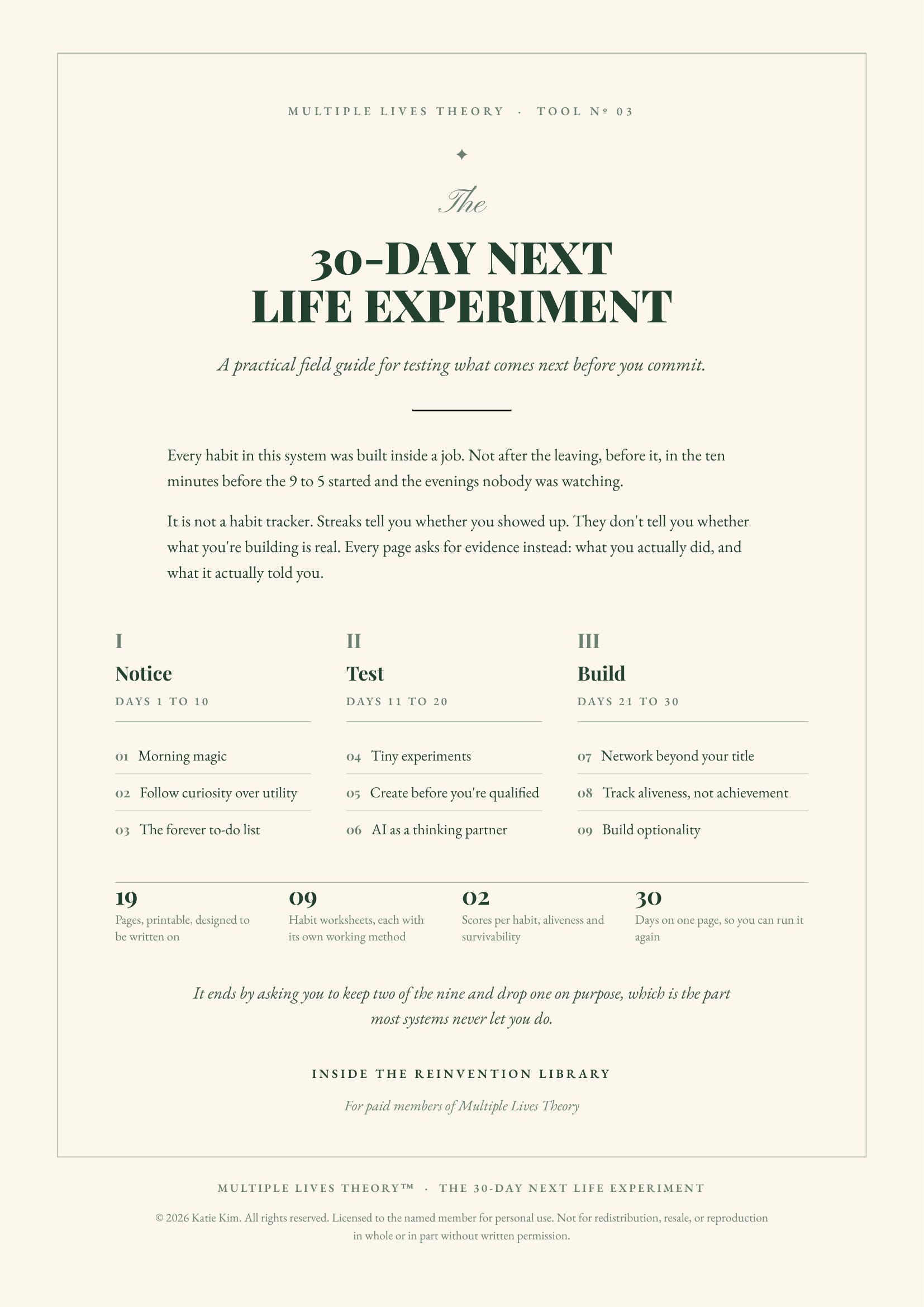
There’s also a re-run tracker, because sometimes the first experiment isn’t the end of the question.
It’s just the first piece of evidence.
The Independent Life Experiment lives in the Reinvention Library, and it’s included for paid subscribers.