


Hi, I’m Katie. Welcome to Multiple Lives Theory (MLT).
MLT is about identity, reinvention, and the lives we imagine but don’t always choose.
These essays explore the questions, ideas and practical ways of thinking that can help us understand what we want, make decisions without having all the answers, and build lives that feel more like our own.
The form had one box for occupation.
It was an ordinary form, filled in at a desk in a rented apartment with a pen that belonged to the building.
I had filled in enough of them that year without thinking about it.
This one I sat with for longer than it deserved, and then wrote the word that matched the invoices, because that was the one that would hold up if anybody checked.
The pause was not because I didn’t know. It was because I had three answers, all of them true, and the box only wanted one.
I have been doing some version of that pause for years.
The question is always the same: which one?
Which one is the real one? Which one would I choose if somebody actually made me?
I ask it in airports, in the shower, at two in the morning.
I’ve asked it often enough now to notice that it has never once produced an answer.
The three are still there, more or less in the same order, wearing more or less the same clothes they had on years ago.
It is tiring in a way that is hard to explain if you have one answer. I think that’s because the tiredness doesn’t come from the work.
It comes from feeling permanently under review.
There is a small shame underneath it too.
Being able to do several things is supposed to be a good problem, so when it doesn’t feel like one, there is nobody particularly obvious to say that to.
The page that became the board
At some point, thinking about the three lives in my head stopped being useful. So I put them somewhere I could actually look at them.
This sounds like nothing, except that after about a decade of taking the question extremely seriously, I had never once written all three down on the same page.
That page is the reason the rest of this exists. It is also where the first problem turned up, in my own handwriting.
Each of the three had a name. Not a description. A name.
And a name is not a neutral label. It arrives with a wardrobe, a schedule, an income, a certain kind of morning, and a way of being described at a party by somebody who is not you.
Names are exclusive in a way that lives are not.
You cannot really be called two things at once, so the moment I gave those three futures names, I had built a competition.
Then I spent years failing to settle a competition I had invented myself.
The problem was not the three lives. It was the list.
The upside is that it at least left me something I could work on.
If the names were doing the damage, I needed to look at the three lives some other way.
The only way I could think of was to stop asking what each life was called and start asking what it would actually consist of on a day when nothing particularly interesting happened.
The life I know, the life I imagine, the life I can’t picture
The first I didn’t have to imagine, because I am in it.
It is the one other people call the safe option, which is funny, because it is the one with the invoices in it.
At four in the afternoon, I am usually inside somebody else’s website, doing work I’m good at, for a person who is pleased with me. What gets better if this continues is that it compounds.
What gets harder is that it compounds in a direction chosen by whoever happens to be paying.
I’m becoming good at a specific thing slightly faster than I’m deciding whether I want to be.
The second is the one where writing is the work rather than the thing at the edges of it. Here, the day goes thin quite quickly.
The morning is easy to picture because I already have it.
The afternoon is where it fails, because in the version I run in my head, the afternoon is more writing, which is obviously wrong because nobody writes all afternoon.
The truthful answer is that I don’t know what most of that day contains.
The parts I can see clearly are the parts I already own.
The third has never made it into a day at all.
I can describe the shape of it for about two sentences: something about making things that are mine and putting them out without a client standing between me and whoever ends up using them.
And then it stops.
For a long time, I took that as evidence that it wasn’t serious. I’m less sure now.
It might be the only one of the three I didn’t assemble out of other people’s versions. And the reason I can’t picture the afternoon may simply be that I’ve never watched anybody else have one.
Put them next to each other and the difficulty stops being quite so mysterious.
One is fully furnished and quietly narrowing. One is half-built out of hours I already like. One won’t come into focus and won’t go away either.
Nobody is wrong, which is the actual problem.
If one of them were obviously a fantasy, this would have resolved itself a decade ago.
But something else happens when you lay three ordinary days side by side, and it took me a while to see it, mostly because I was still looking for the winner.
What I built, because one page could not hold it
By this point, the page had started getting crowded. I had notes in the margins, questions underneath the questions, and had started losing track of which answer belonged to which life. I realised I needed somewhere to put all of this that wasn’t just another page in my notes.
So I built The Three Lives Board.
It lives in the Reinvention Library, and it is an eight-stage guided audit for doing exactly this: holding three possible lives at once and looking at them closely without having to decide which one wins.
That part matters to me. The board isn’t designed to get you to pick a life and commit to it. It is designed to help you understand what keeps pulling you towards each one, what they have in common, what is actually getting in the way, and what you might be able to learn before making anything irreversible.
It starts with Open, where you name the three lives you’re carrying around.
Life 01 is the life you keep thinking about.
Life 02 is the life you wonder if you’re allowed to want.
Life 03 is the life you haven’t considered seriously yet.
That last one can stay empty. I wanted it to, because sometimes there isn’t a third answer yet, and an empty space is more useful than forcing yourself to invent one.
There is one rule at this stage: describe a life, rather than a job title. “Ceramicist” doesn’t tell you very much beyond the thing you already know you want to do. “The one where I make things with my hands and the week has a shape I chose” gives you something you can actually investigate.
From there, the board asks you to spend time inside each life.
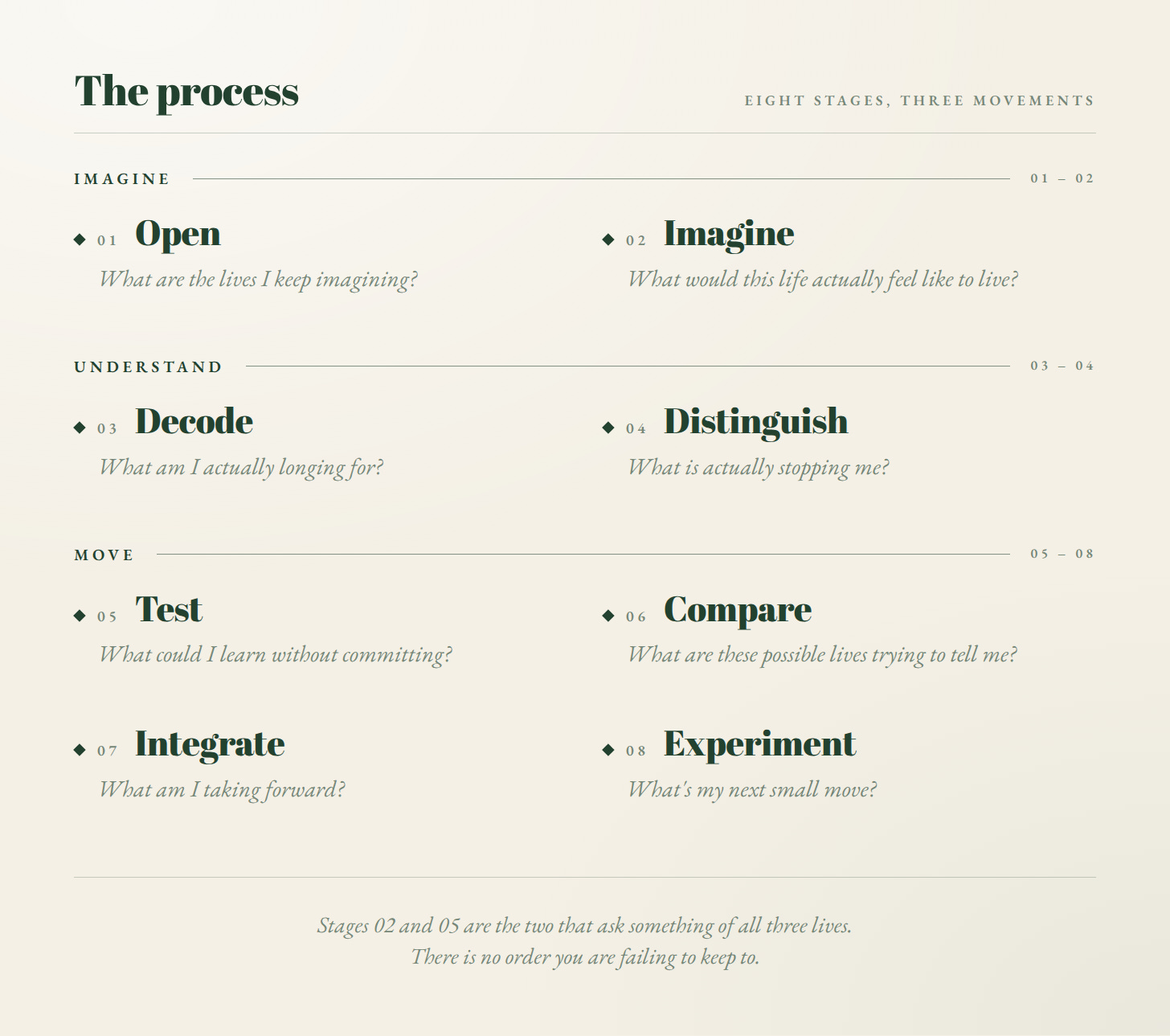
Imagine asks what this life would actually feel like to live, rather than what it sounds like from the outside.
Decode asks what you are actually longing for underneath it. This is where you might start noticing that three very different lives are carrying the same want.
Distinguish asks what is genuinely stopping you, which means putting things like money, people, timing and geography on the page instead of letting them become one large, shapeless reason why you can’t.
Then comes the part I think is most useful: learning without deciding.
Test asks what you could find out about each life without committing to it. You might not be able to live the whole thing yet, but there may be something you can test.
Compare lets you put all three back beside each other and look at what they are telling you as a group.
Integrate is where you look at what can come with you into the life you already have, and what can’t. Some parts of an imagined life turn out to be surprisingly portable. Some really don’t. I didn’t want the board to flatten that distinction just to give you a satisfying answer.
And finally, Experiment asks what you want to try next.
Not a five-year plan. Not a dramatic decision.
Paid subscribers can read the rest of this essay and get full access to The Three Lives Board to map out their own paths
