


Hi, I’m Katie! Welcome to The Multiple Lives Theory. This is a space for anyone rewriting the rules of modern work, embracing a nonlinear career, and actively designing a life of creative freedom outside the standard 9-5 ladder.
There is an entire industry built on telling people to get clear.
Books about it. Frameworks for it. Podcasts. Palm readers. Coaches who specialise in guiding you through it. The advice comes from a good place — from the genuine observation that most people stay stuck because they can’t commit to a direction. That the problem is indecision, and the solution is the deliberate act of eliminating options until one remains.
And that’s right. For a certain kind of person, in a certain kind of stuck.
It’s just not the only kind of stuck.
There’s another kind. The one that gets mistaken for the first. The person sitting with three things that all make genuine sense — three directions, three versions of a life they could actually build, three answers to the question of what they should be doing — and the problem is not that they’re confused. The problem is that they’re not. All three are real. All three fit. And none of them, looked at directly, is obviously the one.
For that person, “get clarity” is the worst possible advice.
Because it implies the solution is to eliminate. To narrow. To sit with the options until one rises and the others fall away. And for the person I’m describing, that sitting doesn’t produce clarity. It produces a kind of low-grade anxiety that looks, from the outside, like avoidance. A feeling that something must be wrong with them — that a resolved person would have figured this out by now.
I know this feeling. I subscribed to the clarity framework for years. I made lists. I used the templates. I sat with the question and waited for the answer to arrive in the form everyone described — a kind of settling, a sense of rightness, a knowing.
It didn’t come. Or it came and immediately argued with itself.
I thought this meant I hadn’t done the work properly. That I wasn’t looking honestly enough, or bravely enough, or that I was protecting something I needed to let go of. So I tried harder. More lists. More journalling. More conversations with coaches who were very patient and very good and who, bless them, could not help me.
Because I wasn’t confused.
I had three real answers. And the clarity framework had no interface for that.
Here’s what I think is actually true — and it took longer than I’d like to admit to understand. Clarity isn’t a prerequisite for starting. It’s what starting produces. The people who have arrived somewhere clear — who can say, without rehearsal, what they do and why — they didn’t get there by sitting and deciding. They got there by moving. By trying the first real thing and letting it generate information. By discovering, through action, what they needed to know about themselves that thinking couldn’t give them.
The clarity framework inverts this. It asks you to know before you go.
And for the person with three real answers, that sequence is a trap. Because none of the three will reveal itself as the clear winner in the abstract. They have to be tested. Tried. Made. Taken somewhere and confronted with reality. And what you’ll find, when you do, is not that one answer was right all along — but that the experience of choosing one tells you things the other two couldn’t.
The advice assumes the problem is confusion. It doesn’t account for the person who simply has three real answers and needs to start, imperfectly, with one.
This is the part that helps me now, when I feel the familiar pull towards more deliberation. I ask myself: is this confusion, or is this just the discomfort of moving without complete certainty. Because those are different feelings. Confusion has a texture of not-knowing. What I’m usually dealing with is a texture of not-yet-knowing — which is another thing entirely.
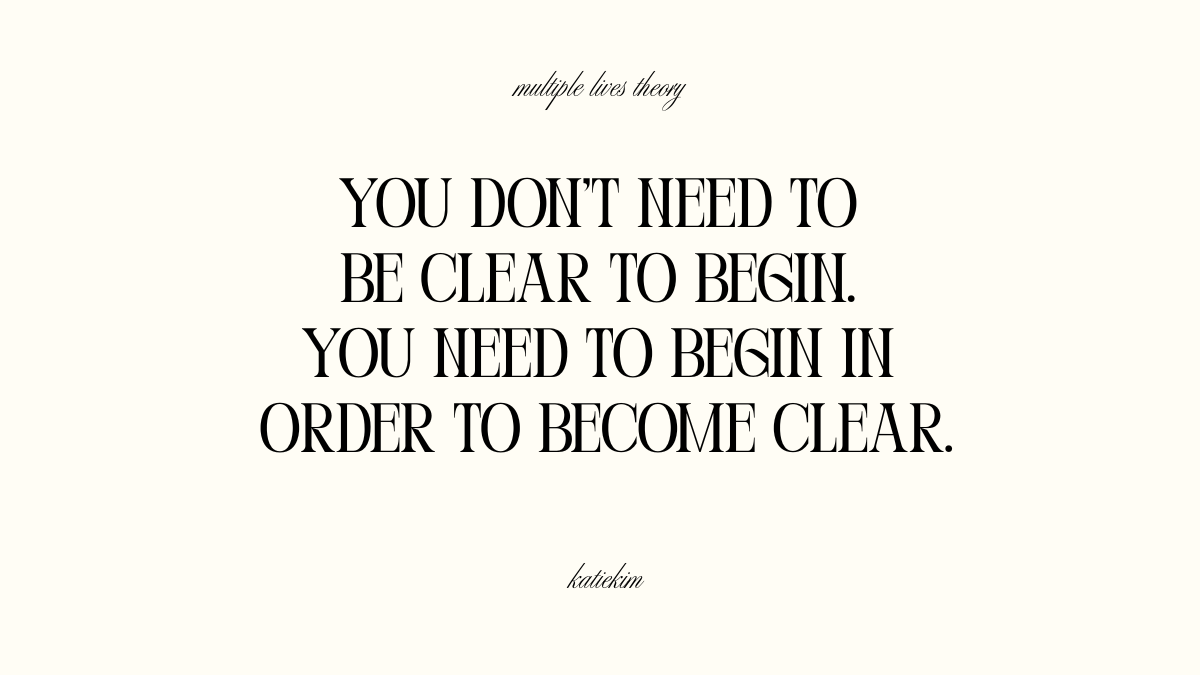
You don’t need to be clear to begin. You need to begin in order to become clear.
Pick the realest of the three real things and take one small action towards it. Not a commitment. An experiment. Something that will generate information you don’t have yet.
The clarity will follow.
It always does. Just not in the order the framework promised.
What’s the version of clarity nobody gave you a map for? I’m genuinely curious what the answer looks like from where you’re sitting.
This feels so real :)
Love this! beautifully written & highly resonates. My first post is about something similar, a framwork that allowed me too stop living in my head too much and actually just do the thing! The way you articulated yourself was impressive!