


Hi, I’m Katie! Welcome to The Multiple Lives Theory. This is a space for anyone rewriting the rules of modern work, embracing a nonlinear career, and actively designing a life of creative freedom outside the standard 9-5 ladder.
The maths that stops you was never actually calculated
There’s a kind of maths that runs in the background of every career-change conversation, and it almost never gets written down.
It goes: I’m thirty-one. If I start something now, I won’t have real traction for two years. The people already doing this have a ten-year head start. By the time I have what they have, I’ll be forty-five.
I know this maths intimately, because I ran it, in various configurations, for about three years before I stopped. It was always available when I needed a reason to wait.
The calculation that runs in the background
What I never did, for an embarrassingly long time, was check it. I treated it as a fact about the world rather than a sum I could actually sit down and do. It hummed away, generating reasons to wait until the conditions were better, until I was more prepared, until the risk felt smaller and it never once resolved, because I never once wrote it down.
Anxiety maths vs actual maths
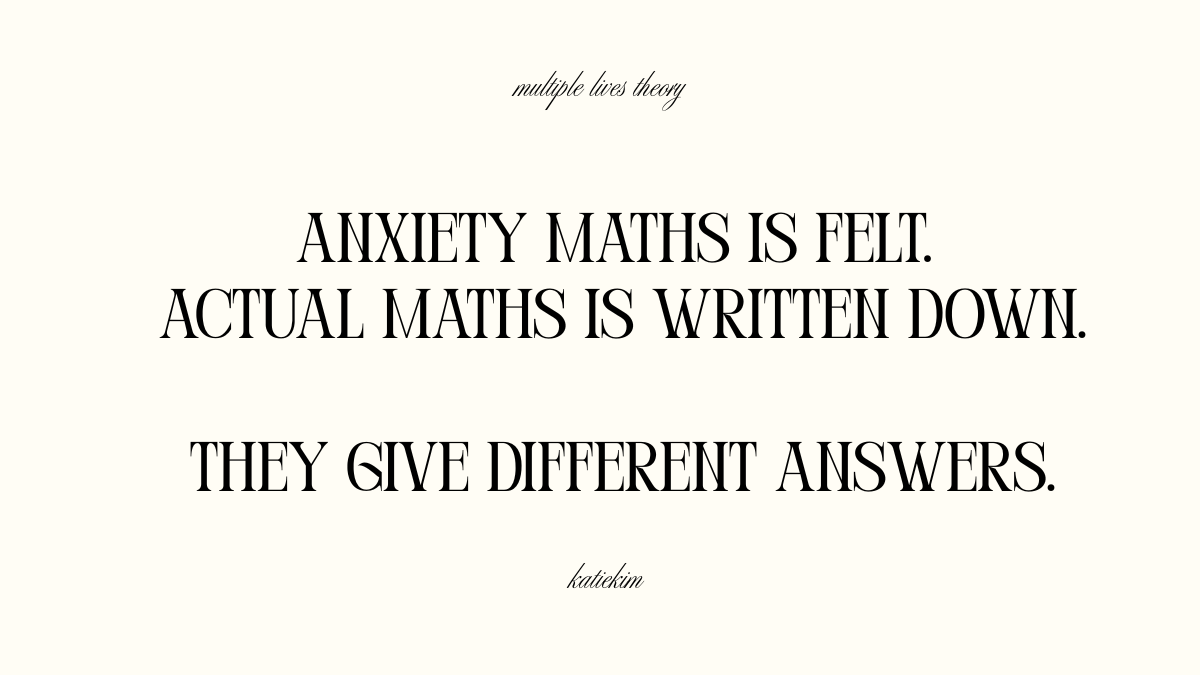
Anxiety maths is felt, not computed. It runs in the background, uses no real numbers, and exists mainly to justify waiting. Actual maths is written down. It uses your real figures, includes the cost of staying, and uncomfortably tends to produce a different answer.
When I finally ran the actual version, I found the anxiety calculation had three structural errors in it. Not emotional errors.
The maths was simply wrong.
Where the anxiety maths goes wrong
The compound-interest assumption. Anxiety maths measures the gap between where you are and where someone established is now, then projects how long to “catch up.” But catching up assumes the same trajectory. The person ten years ahead is optimising within a lane; you’re still in the steep part of your own curve, where everything you learn changes how you learn. The gap is real. The projection is wrong.
The opportunity-cost miscalculation. Anxiety maths adds up what you’d give up, salary, stability, status — but almost never subtracts what staying costs: the skill atrophy, the network you’re not building, the options quietly closing while you wait. Staying has a price too. The sum should include it.
The “is it too late” binary. This frames the question as yes-or-no, and conceals a premise — that there’s a correct time you may have missed. But almost nothing worth doing has a correct time. It has a range. And within that range, earlier beats later, so the honest answer to “is it too late” is almost always: later than if you’d started when you first thought about it, and earlier than if you wait.
What I actually did (the numbers)
I’m sharing these because most people don’t, and the opacity feeds the anxiety. I had roughly seven months of living expenses saved. I had two small clients I’d been working with part-time for about four months, generating around a third of my old salary. I had a plan to reach full income replacement in twelve months, and I was wrong about the timeline altogether. It took about fifteen in total.
The gap was uncomfortable and manageable. The numbers weren’t special. They weren’t a set of circumstances that made the decision obviously sensible. They were enough (barely) to make it survivable. And survivable, it turns out, is the relevant threshold. Not safe. Not certain. Just survivable.
Why nobody writes it down
Writing the maths down makes it real in both directions. It makes the risk real. The exact number of months you could last, the exact income you need to hit. But it also makes the survivability real, and the survivability, looked at with actual numbers rather than anxiety, is usually far less catastrophic than the background hum suggests.
How to run the actual maths
1. Write the number down. A vague calculation can’t resolve. A written one can.
2. Include what staying costs. Not just the salary you’d keep but the options you’d lose.
3. Find the floor: survivable, not safe. You’re not solving for certainty. You’re solving for “can I get through the gap.”
4. Treat “too late” as a premise, not a fact. Ask what correct-time it’s secretly assuming, then check whether that time exists.
5. Decide on the real number, not the feeling. They’re almost always different.
What surprised me
When I finally ran my own numbers, the thing that surprised me was how much energy I’d been spending just maintaining the anxiety version.
The vague, unexamined calculation takes constant work. It hums and never settles. Writing it down made it less consuming, even when the answer was harder than I’d hoped. A real number, however uncomfortable, has an edge.
And you can work with an edge.
— Katie
What calculation have you been running in your head that you’ve never actually written down? Reply and tell me, or if you’ve done the maths, I want to hear what it said.

More from Multiple Lives Theory:
→ the reinvention story we’re not telling — on why moving comes before clarity
→ the relief you’re not allowed to feel when the job ends — on the honest feeling underneath the leap
✍️ New here?
🍀 Multiple Lives Theory is for people in the in-between, when the life you’ve built no longer quite fits, but the next one hasn’t taken shape yet.
A new free essay lands every Sunday.
Paid members get access to The Multiple Lives Library, a growing collection of decision maps, workbooks, digital artefacts, Notion dashboards, and practical frameworks for figuring out what you actually want and experimenting with what comes next.
The essays are where we make sense of the questions. The Library is where we start turning them into experiments.
Written from inside the transition, not the other side.
I loved this Katie! One thing I've noticed coaching executives, and in my own life, is that people tend to overestimate the cost of changing and underestimate the cost of staying. We spend so much time calculating the risk of the leap that we forget to calculate the cost of staying somewhere that no longer fits.
This hit me harder than I expected, Katie. Especially the part about anxiety maths running in the background, unexamined, humming away and generating reasons to wait. I’ve carried that hum for years – not just about careers, but about almost everything that mattered.
What struck me is how similar this is to something I’ve been thinking about in a completely different context: the way we let algorithmic anxiety run our lives without ever writing it down. We feel the manipulation, the narrowing of options, the quiet closing of doors – but we never compute it. We just live inside it.
Thea, you said "is it even worth starting?" – and that question is the binary Katie deconstructs so beautifully. Michaela, your story about studying drama at 35 made me realise: the actual maths of starting isn't just about money. It's about the room that opens in your head and heart when you stop asking for permission. And Melissa, yes – fear keeps us in avoidance, but what if the rearrangement isn't just about stability, but about reclaiming the narrative of your own life?
I wrote something recently about how we live in Plato's cave and don't even know it – how most of us mistake shadows for reality because we never turn around and do the actual calculation. Katie's article feels like a map out of that cave. Not a guarantee, but a compass.
If anyone here is curious about what happens when you start questioning the narratives we're handed – about time, about worth, about who gets to decide what's "too late" – I've been exploring exactly that in my own writing. Not with answers, but with questions that refuse to stay quiet.
Thank you for this, Katie. You've given me a new number to write down