


Someone always asks it right as you’ve got a mouthful of food. My aunties do it leaning across the table, fork still in his other hand, in the voice people use for a genuine, generous question.
“So — how’s the business going?” And there’s a full second where I have to decide which answer I’m giving: the true one, the safe one, or the one that will let us get back to the roasted beans.
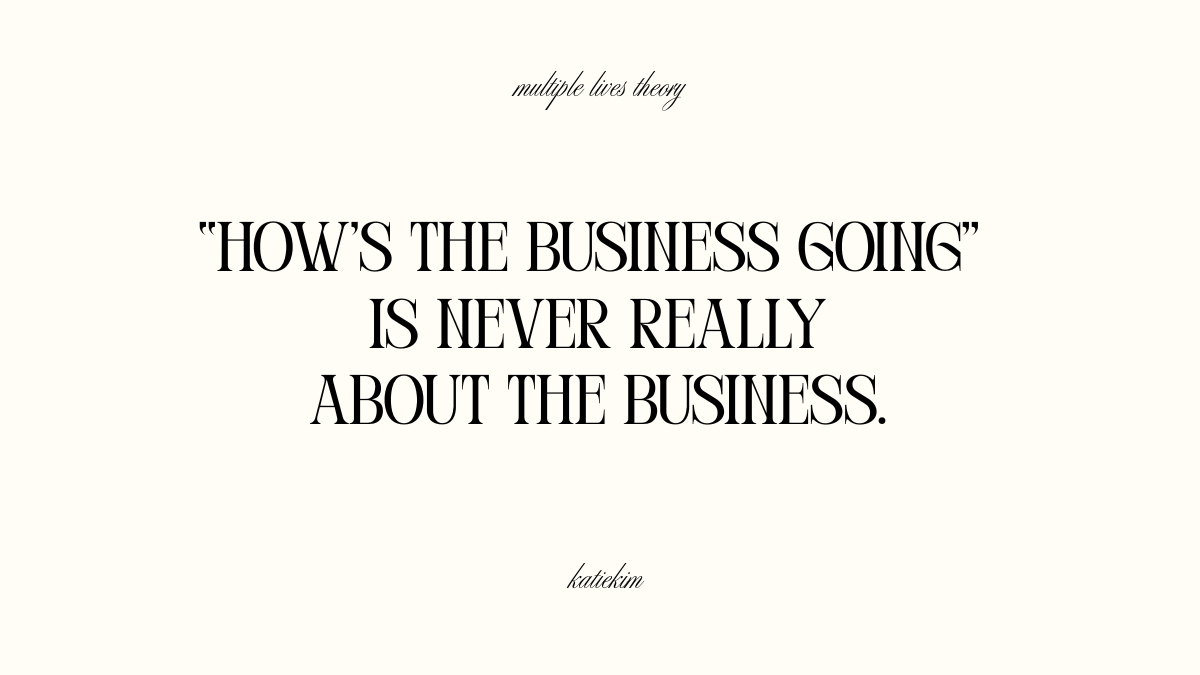
The question that sounds like data
On paper it’s an information request. Revenue, clients, trajectory — a business update, the kind you’d give a shareholder. That’s the shape of the sentence. But I’ve sat across enough of these dinners now to know the shape of the sentence and the shape of the actual question are two different things, and mixing them up is where the trouble starts.
What they’re actually asking
Nobody at that table wants a P&L. What they’re actually asking, underneath the business language, is: are you okay? Should we be worried about you? Did the thing you did — the leaving, the risk, the thing that made your mother go quiet for a week — did it work in the simplest, safest, most reassuring sense of the word “work?”
Information wants numbers. Reassurance wants a feeling. They ask for the first and need the second, and the mismatch is why almost every answer you give feels wrong even when it’s accurate.
Why the true answer never lands
I tried the honest version for about a year. Full picture — the good quarter, the client who ghosted, the number that’s climbing but slower than I’d like. Delivered as neutral fact, the way I’d want it delivered to me. It landed badly every time, not because the facts were bad but because a nuanced true answer doesn’t produce a feeling fast enough. By the time I got to the reassuring part, the table had already filed it under “not going well” and moved to concerned faces. The truth was too slow for the question actually being asked.
The doctor’s-office version
A friend who’s a GP told me something that reframed this for me completely: patients almost never want the full clinical picture when you ask “how are you feeling” — they want to know if they should be scared. She said the real skill of the question isn’t gathering symptoms, it’s reading which kind of answer the person in front of you actually needs first: the data, or the “you’re going to be fine.” Get the order wrong and it doesn’t matter how accurate you were.
How I actually answer now
I’ve started giving the reassurance first, deliberately, before anything else. “It’s going well — slower than I’d like some months, but well.” True, and it does the actual job the question was asking, which was never really about the spreadsheet.
Reading the table before you answer, once you notice it:
You start translating before you’ve even swallowed. The mouth is still full and the sentence is already being rewritten for the room.
You give the version with a shape, not the version with the truth. Shape first. Truth, if there’s room after.
You notice who’s listening for content and who’s listening for tone. It’s rarely the same person twice, and it’s almost never who you’d guess.
You resent the question more than the person asking it. They usually mean it kindly. The resentment is really about the mismatch, not them.
You’ve started answering the reassurance instead of the number. Once you notice this, you can’t fully unnotice it — every “how’s it going” becomes two questions instead of one.
What I still haven’t solved
I still don’t know what to do the year the honest answer and the reassuring answer point in genuinely different directions — when it isn’t going well and there’s no shape I can give it that isn’t also a small lie. I’ve been lucky enough that this hasn’t come up yet. I think about the dinner where it will, and I don’t have a script ready for that one.
— Katie
What’s the worst version of this question you’ve ever been asked, and what did you actually say back? Reply and tell me. I’m reading the answers people gave versus the ones they wanted to give.
More from Multiple Lives Theory:
→ What happens to your identity when you remove the job title — on who you are underneath the shorthand
→ The multi-passionate person’s guide to answering “what do you do” — on describing a life that doesn’t fit one title
✍️ New here?
🍀 Multiple Lives Theory is for people in the in-between, when the life you’ve built no longer quite fits, but the next one hasn’t taken shape yet.
A new free essay lands every Sunday.
Paid members get access to The Multiple Lives Library, a growing collection of decision maps, workbooks, digital artefacts, Notion dashboards, and practical frameworks for figuring out what you actually want and experimenting with what comes next.
The essays are where we make sense of the questions. The Library is where we start turning them into experiments.
Written from inside the transition, not the other side.

I get “this is just for a year, right?” But this one is on me— I’ve shared this is my one year experiment to figure out the next thing. It’s true, based on the numbers and my plan. But deep inside, I hope, wish, dream this doing-my-own-thing will work out for good, forever. Thanks for asking the question— I don’t think I’ve said that out loud before. Maybe this is the start of manifestation!
This is a really interesting point actually! I think sometimes people are asking ‘did the risky thing work out?’ Rather than actually wanting the numbers or ins and outs of the work. I usually stick to ‘pretty good but wouldn’t mind an extra client or two!’ and move on