

Four of My Interests Became Income Streams. Here's What I Learned.
My 4-step process to go from a decade of abandoned projects to the ones that could actually earn (plus the Claude prompt that finds them)

Hi, I’m Katie. Welcome to The Multiple Lives Theory, where I write for people who have outgrown a version of a life they worked hard to build. Essays from inside the transition, weekly.
This is the first of my series called Sessions, which is a name I have only recently settled on for something I have been making for a while.
A Session is an essay with a working part attached. The essay is what I think about something. The working part is the thing I actually use, and in this case it is a prompt you can run on your own list by the end of the afternoon.
I wanted to start here because it is the least flattering thing I know about my own working life and also the most useful so far.
The folder of ideas that came with me
It is not really a folder.
It is a few folders, some domains I have kept renewing for reasons I could not defend, three podcast episodes sitting on my hard drive, and a handful of things still live on the web that I have not looked at in years.
I call it the folder because that is easier than saying I have started a lot of things and finished a few.
When I stopped having a salary, I assumed some of this would sort itself out. The unfinished projects had stalled because I was tired, I thought, or because there were only so many hours after work.
Once the hours were mine, I assumed the half-built things would either get finished or stop mattering.
That is not what happened.
I left, the folder came with me, and within four months I had added to it.
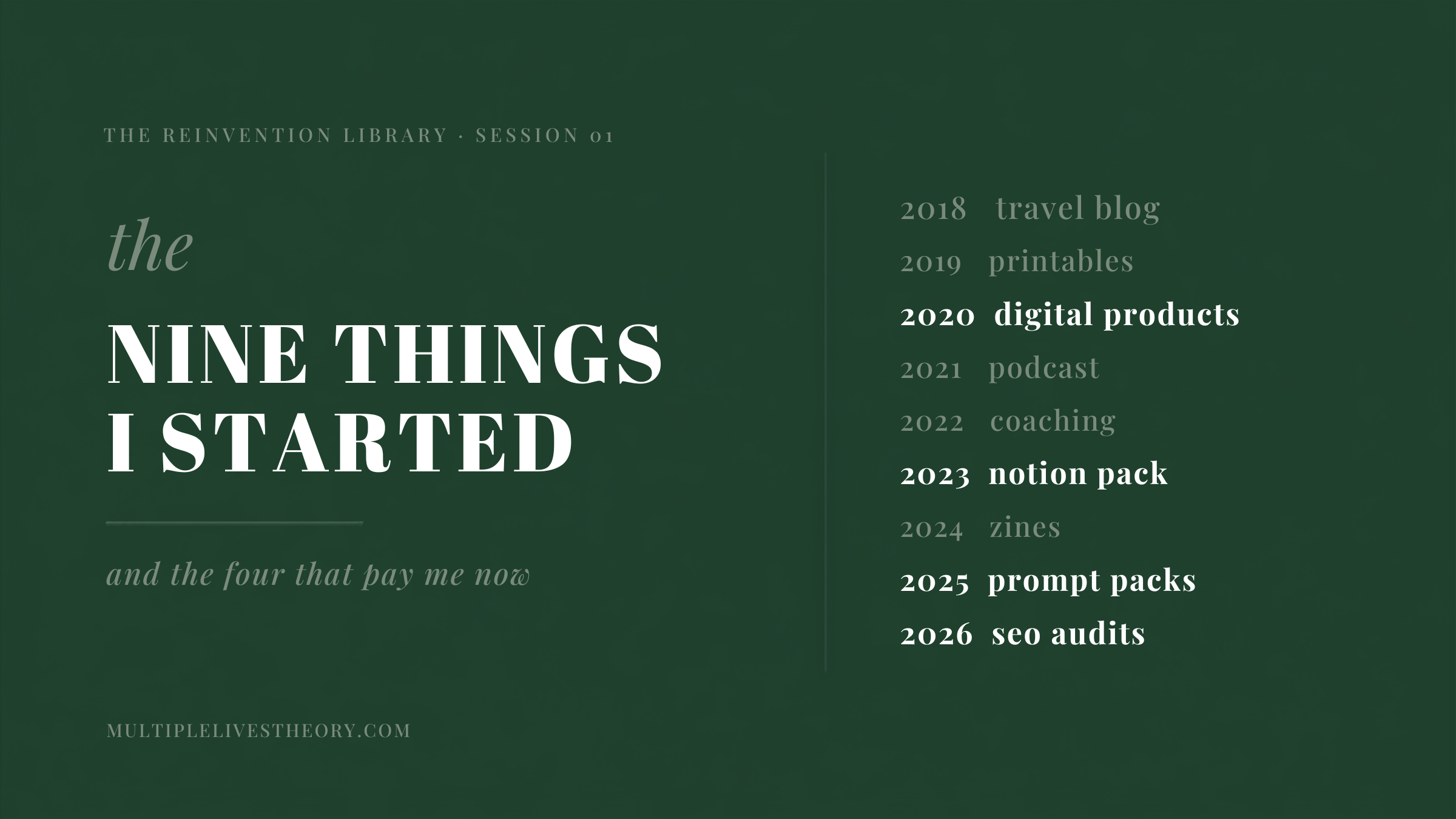
Here is the actual list, which I had never written down in one place before and would rather not have.
2018. A travel blog. Tips, itineraries, the whole thing.
2019. Journal printables, sold online, alongside self-taught coding tips on an Instagram account called Katie Kodes, now deactivated.
2020. WordPress, Shopify and Squarespace templates, still floating somewhere on the web.
2021. A podcast. Three episodes recorded, none published.
2022. A domain for a career coaching thing. Bought it, never built it.
2023. A Notion template pack. Dashboards and tools for career changers.
2024. Online zines about tea and coffee, because I wanted to bring the beverage thing into the world somehow.
2025. An Etsy and Gumroad store selling digital marketing tools and AI prompt packs for small businesses.
2026. SEO audits and website templates.
Nine, give or take, depending on whether you count the things that never got past a domain name.
I am not going to pretend that list is fine. Some of it is abandonment. There were months when I started something new mainly to avoid finishing something old.
Most of them are dead and should stay dead
I want to say this early because the tidy version of this essay would not.
The comforting story is that every abandoned thing taught you something and that the skills carry forward.
Some of that is true.
Plenty of what I stopped doing, I stopped because it was not good, because I was the wrong person for it, or because I only wanted it in the way you want something at eleven at night.
The travel blog is dead.
The podcast is dead, three episodes into a medium I did not enjoy.
The coaching domain expired without a single page on it.
The tea and coffee zines still interest me, and I am fairly sure they were never a business. They were something I wanted to exist.
Those things are not lessons. They are things I did not do.
Admitting that makes the rest of the list easier to read. When every abandoned project has to mean something, you miss the ones that actually have a pattern.
I did not start nine things
This is the part I did not see until I put the list in order.
The printables in 2019, the Notion pack in 2023, and the prompt packs in 2025 are the same idea: make a small useful thing and put it somewhere people can buy it.
The WordPress, Shopify and Squarespace templates in 2020 and the website templates in 2026 are the same idea again.
The coding tips on Katie Kodes in 2019 and the SEO audits in 2026 are also related.
So I did not abandon nine unrelated projects.
I started about three things, several times each, in different clothes, and quit each version before anyone had much chance to pay me for it.
That is worse to admit and much more useful to know.
A person who abandons nine unrelated projects may have a focus problem. A person who keeps restarting the same three things has probably been circling something.
I had been reading my own list as evidence that I was flaky.
It was closer to evidence of a direction I kept refusing to commit to.
I think that is because starting again feels like ambition. Finishing feels like a verdict.
The signal is not how you felt about it
For a long time, I sorted the list by whether I had liked doing each thing.
That sounds sensible and is mostly useless.
I liked nearly all of them at the start. Enthusiasm at the beginning tells you very little.
The useful question turned out to be much duller:
Did anyone ever ask you for it without you offering first?
A compliment does not count. Neither does someone saying it is a good idea.
I mean someone coming to you and asking whether you could do that thing, make that thing, or whether it was available.
Most people have had this happen and ignored it because it arrived in a message months ago and looked like a favour.
Mine was a founder at a femtech health company asking whether I could redo their web architecture.
I treated it as a favour with a fee attached rather than information.
It did not feel like a business arriving. It felt like someone I knew needed a website, and I could do it, so I did.
That was the clue.
The useful question is which of your abandoned ideas somebody came looking for while you were busy looking elsewhere.
The four steps
1. Get the whole list out, including the embarrassing ones.
Write down the domains, courses you outlined and never recorded, things you built for one person, and projects you stopped mentioning.
The list only works if it is complete. The ones you would leave off are often the ones where somebody asked for something.
Put everything in order by year.
2. Look for the repeats before you look for the winners.
Read the list from the beginning.
Mark anything that is the same idea in different clothes. You will probably find a few clusters and some genuine one-offs.
The clusters tell you where you keep returning when nobody is making you do anything.
3. Mark every unprompted ask.
Go through each project and ask whether somebody came to you about it without you raising it first.
Be strict. Encouragement does not count. A friend saying you should do it does not count.
Someone asking whether they can have it, buy it, book it, use it, or whether you would do it again does count.
If there was an ask, write down who made it and roughly what they said.
4. Put a number on it and say it to one person.
You do not need a business plan. You need a price and one person who might pay it.
This is where a project either leaves the folder or stays there for another two years while you tell yourself you are still deciding.
So that’s the exercise. Here’s what it gave me when I ran it on my own list.
The four projects that pay me now
The four are website work, SEO audits, coaching, and digital products.
All four are on that original list.
The website work came from the templates.
The audits grew out of the coding and website work.
The digital products are the printables on their fourth attempt.
The coaching idea has been sitting in some form on the list since 2022.
None of these arrived as a perfect business idea. They kept coming back.
And more importantly, people asked for them.
I would like to tell you I recognised this at the time. I actually did not.
They sat there while I worked on things that looked more like proper businesses. I eventually returned to them because I needed the money and they were the projects on my list that somebody had actually asked me for.
That is a much less glamorous reason to make money from a passion.
It is also a more useful one.
Where this stops working
There are two places where this exercise can give you an answer you do not like.
The first is that some folders are simply graveyards.
If you find no unprompted asks anywhere on your list, that is a result. It means the things you have been building may be things you wanted to have built rather than things other people wanted to buy.
The second is that the project with an ask attached may be the one you are least proud of.
Mine is not the thing I would lead with at dinner.
There is a cost to reopening something you had quietly decided was beneath the version of yourself you were trying to build.
You should know that cost before you price it.
There is another pile I did not expect: things people keep asking for that I no longer want to do.
Demand on its own is not a reason.
Some things should stay in the folder even when people want them. The question is whether you would still be willing to do the work six months from now.
I also want to be careful about what this exercise can promise.
You may have one thing somebody once asked for. That does not make it a business.
It may be worth two weeks of attention.
It may make some money.
It may tell you something about the direction you keep returning to.
That is enough.
For me, these four projects now pay some of the bills.
It is not what I imagined I would be doing.
I still catch myself describing the work as the small thing I do on the side, which, after 12 months, is starting to sound like a lie I tell for the sake of a tidier story.
The zines are still in the folder.
I have not worked out whether that is the one honest thing on the list or just the next thing I am going to quit.
There’s one more thing, and it isn’t about the list.
I’ve used Claude for a couple of years as a lean coworker. It challenges my thinking, gives perspective, helps me sort through technical complexity. That part isn’t new.
What was new was pointing it at myself. I’d been using it on work, never on the story I tell about my work, and those turn out to be very different jobs. The prompt below is written to refuse encouragement, to reject a yes I can’t back up with a person’s name, and to quote my own dismissive phrasing back at me at the end. I had to write those rules in deliberately, because the default behaviour of every one of these tools is to agree with you warmly and let you leave feeling productive.
So the shift is smaller than it sounds. I stopped asking it to make things and started asking it to notice things. It isn’t smarter than me about my own list. It just has no investment in the story I’ve been telling about that list for nine years.
I sorted nine years of work by how I felt about each thing. It sorted by what was actually there.
The prompt is below, for paid subscribers. It’s the version I run, not a cleaned-up one. About twenty to thirty minutes and you’ll have a shortlist with a price and a date on it.
Keep reading with a 7-day free trial
Subscribe to The Multiple Lives Theory to keep reading this post and get 7 days of free access to the full post archives.