


Hi, I’m Katie! Welcome to The Multiple Lives Theory. This is a space for anyone rewriting the rules of modern work, embracing a nonlinear career, and actively designing a life of creative freedom outside the standard 9-5 ladder.
The question came up at a dinner a few months ago. Someone asked how I’d ended up doing what I do, and I heard myself begin to answer.
I gave the version I always give. The one that starts with design and moves through web design, naturally towards UX and lands neatly on freelance, as if the whole thing had a through-line I’d been following deliberately.
As if each move was a decision I’d made with foresight rather than a pivot I’d made because something wasn’t working, or something else looked more interesting, or I’d simply changed. It’s a good story. I’ve told it enough times that I almost believe it. Hah.
The truth is, it’s messier than you think, and I think even more wildly interesting.
I’ve been a dual frontend developer and content designer. Then a web designer. Then a UX architect inside a large corporate structure, which is its own particular kind of identity. Then a freelancer, briefly, who went back to full-time when it got scary. Then someone building my self-run e-commerce brand Namisan alongside a corporate job, quietly, while still calling myself a web architect on paper.
And now: actually freelance, actually building, actually not sure what the sentence is yet.
Five different people. Maybe more, if you count the versions in between.
For a long time I treated each of those transitions as something to explain away. A gap to paper over. A detail to omit from the LinkedIn profile because it complicated the arc. The freelance period that didn’t last became “exploring options.” The pivot from development into design became “following my interests,” which is true, but it’s also the version that sounds most intentional in retrospect.
I spent years making my career sound more coherent than it was.
Herminia Ibarra writes in Working Identity about what she calls “provisional selves” — the identities we try on in the process of becoming. Career transitions, she argues, aren’t a straight path toward a predetermined destination. They’re a crooked journey. You inhabit a version of yourself provisionally. You test it. Sometimes it holds. Sometimes it doesn’t, and you move on to the next one.
I’d read that and thought it was about the future. About who I was becoming.
I didn’t realise it also applied backwards.
Every version of me that felt like a detour was actually a provisional self I was testing. The developer who realised she cared more about the experience than the code. The UX architect who got very good at the craft and then started to notice what the craft was costing her. The gutsy freelancer who decided to have a taste of freedom, went back to getting a full-time job when the uncertainty got too loud, who learned something specific and useful from that — about what she actually needed, and what she was willing to trade for stability.
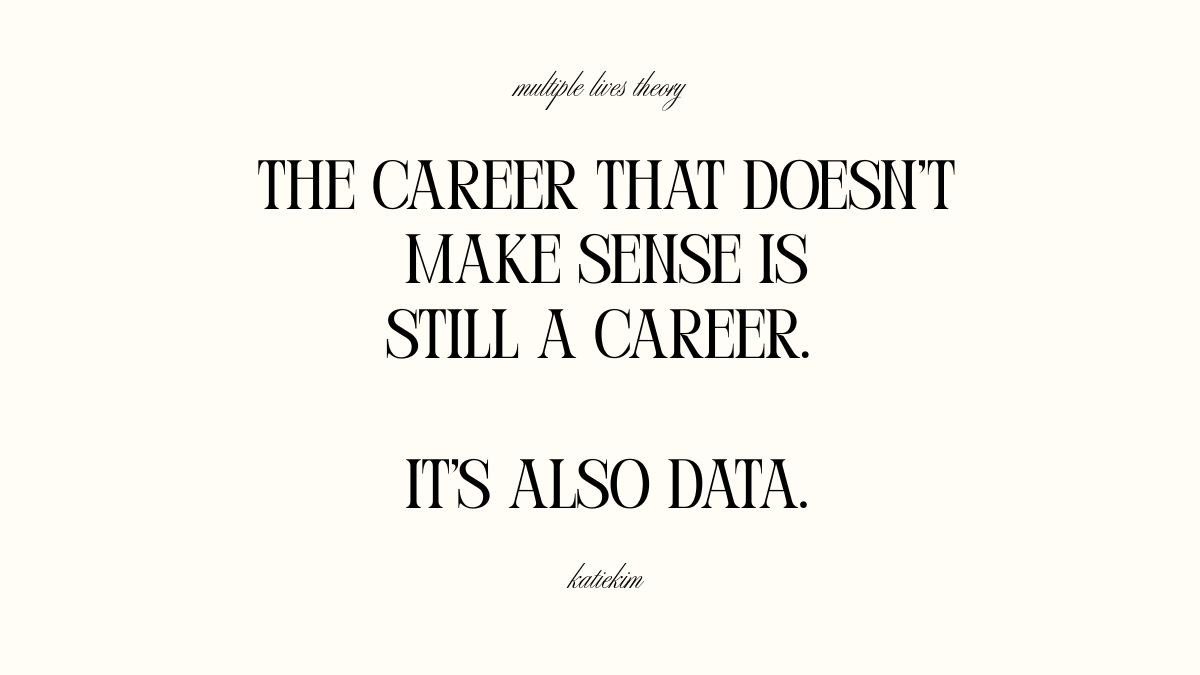
None of those were wrong.
They were information.
I think the part that’s hardest to sit with isn’t the non-linearity itself. It’s the way we’ve been taught to read it. A career, the implicit script goes, should have a protagonist who knew what she wanted and moved toward it. Cleanly. With accumulating evidence that she was right. The CV should tell a story of arrival, not a story of wandering.
Any deviation from that arc — the pivot, the return, the sideways move, the gap — gets coded as something to recover from. Something to explain.
But what if it’s not? What if the pivots are the most honest part of the story?
Every time I moved, I moved because I’d learned something the current chapter couldn’t hold anymore. The developer learned she wanted to shape the whole experience, not just build it. The architect learned that being very good at something inside a large organisation isn’t the same as building something of your own. The person who went back to full-time learned that fear isn’t a good enough reason to stay anywhere.
The through-line isn’t a career direction.
It’s a person trying to figure out what she’s actually for.
I’ve stopped trying to make the story linear. Partly because I don’t think it is, and partly because my e-commerce shop exists, and the newsletter exists, and neither of them fit neatly into the arc I was performing.
They’re the parts that feel most mine. The parts I made because I wanted to, not because they made sense on paper.
Those don’t have a place in the polished version of the story.
I’m starting to think the polished version isn’t the one worth telling.
There’s something that shifts when you stop treating the non-linear path as a problem to manage and start reading it as a pattern instead. Not “how do I explain this?” but: “what is this actually telling me?” The developer who wanted to shape experiences. The architect who wanted to build something real. The person who kept returning to making things, whether it was a UX system or a small package of products for someone she’d never meet.
The data is all there.
I’ve just been trying to suppress it into a neater shape.
I’m 32 and I’ve been five different people at work and I’m not sure what number six looks like yet. But I’m pretty sure she isn’t going to apologise for the ones that came before her.
None of them were wrong.
They were her, working it out.
Do you feel that sometimes on your journey?