


Hi, I’m Katie. Welcome to Multiple Lives Theory (MLT) 🍀 — a place for anyone who has ever wondered: “How many lives can I live within this lifetime?”
MLT is about identity, reinvention, and the lives we imagine but don’t always choose. These essays explore what those possibilities can tell us about what we want — and how to make decisions when more than one life feels possible.
When I was twenty-one I wrote a list.
Get the job. Get the experience. Earn more. Build something. Prove you can do it.
I can still recite it to this day, almost word for word, which probably tells you how often I went back to look at it.
Over the next ten years I ticked off every item. Not quickly and not easily, but all of them, roughly in order, the way you’re supposed to. And every time I reached one, the same thing happened. I felt a strange kind of nothing.
It wasn’t disappointment.
Disappointment feels like a reaction and I could have done something with a reaction.
This was flatter. Like it was muted.
A day and a half of being pleased, then the scanning would start up again for the next item.
How long is a day and a half supposed to last, for a thing you spent four years on?
The first time I remember it properly I was still at university. I’d studied for weeks for a science exam, I got the mark I wanted, and I felt nothing at all. I stood there waiting for the feeling to arrive. It didn’t. I decided I was probably just tired.
Then I did exactly that for another decade.
This was September in Sydney, my second year at a global enterprise company.
What I was actually thinking — and I can quote myself because I eventually wrote it down, was this: what’s wrong with me, everyone else thinks I’m doing amazing, why don’t I feel amazing.
Nobody noticed, and I don’t blame them.
I’m an energetic person. I hype people up, I ask a lot of questions, I’m interested in what everyone else is doing.
That reads, entirely reasonably, as somebody who is fine. Somebody would ask how it was going and I’d say it’s going great. Day to day, same old. My own tone was the evidence against me.
This has a name, it turns out.
The psychologist Tal Ben-Shahar, who taught positive psychology at Harvard, called it the arrival fallacy: the belief that once you get there, wherever there is, you’ll finally feel the way you’ve been promising yourself you’ll feel.
He noticed it first in himself, as a young squash player. He’d win a match or a tournament, feel happy for a short while, and then the next goal would appear and the feeling would be gone.
I read that and recognised the day and a half immediately.
If you’ve felt this, it’s worth knowing that it’s common enough to have a name, and that it happens to people who are good at reaching things.
It isn’t a sign that you’re ungrateful or that something is missing in you.
You arrive, the feeling doesn’t, and because everyone told you it would, you assume the fault is yours.
The advice that usually comes with it is to enjoy the journey, or set better goals. I don’t think that quite reached my problem. The goals were fine as goals. What I’d done was ask a list to tell me who I was, and a list can’t do that.
So I left the job. I’d assumed, without ever saying it out loud, that the nothing was attached to it, and that removing the job would remove the nothing.
Three or four months later I was at my desk on a weekday afternoon doing admin.
Invoices. A form. An email I’d been avoiding for about a week. And I sat there and thought, quite calmly, that I might have made a massive mistake.
Same feeling. Different room. Nothing left on the list, nobody left to prove anything to, and there it was anyway.
That’s when I stopped being able to blame the job.
If you’ve ever changed the big thing, the job or the city or the plan, and found the same feeling waiting for you on the other side, you’ll know how disorienting that is. It’s also useful information.
It tells you the answer was never going to come from swapping the room.
And this is the part I most want to get right, because it’s where I nearly went wrong a second time.
When a life you worked hard for stops fitting, there’s a very convincing next thought. If the list was wrong, then the decade was wrong. The job, the title, the money, the years of proving things. All of it was a mistake, so the honest move is to throw it out and start again from nothing.
You might recognise the voice that comes with it. I’ve wasted ten years. I should have known sooner. Everyone else is ahead and I’m about to go back to the start.
It feels brave. It feels like the opposite of the list.
But I think it’s actually the same thinking wearing a different outfit.
The list said a thing is either done or not done. Burning it all down says a life is either right or wrong. Both leave you standing in an empty room.
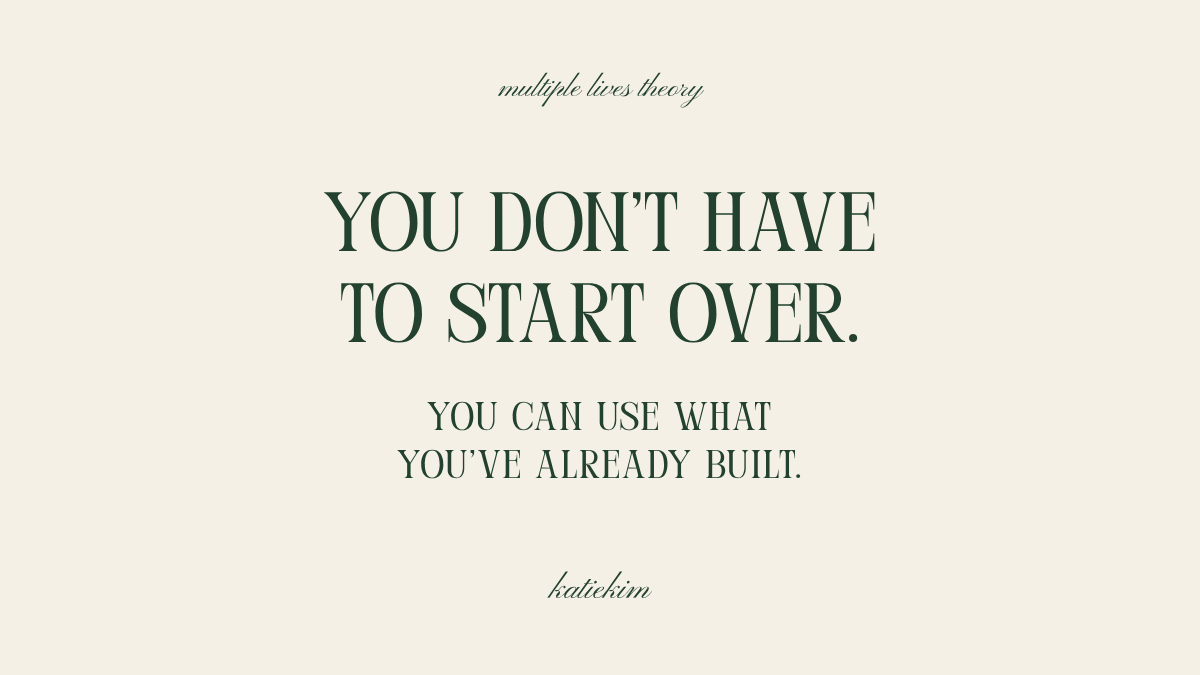
What I’ve been trying instead is closer to recycling. Or upcycling.
Taking what the old life left behind and making something with it that the old life never had in mind.
Because the list left a lot behind. That’s the part the nothing hid from me.
Every item felt empty on the day, and none of them actually were.
The shift out of medical research, the hustle years in tech, the businesses I built after the nine to five.
I’ve written before about the years I thought I wasted, and how often the useful part is exactly the part we cut from the story.
The templates I sell, the websites I build for clients, this newsletter. None of them were on the list. All of them are made from what the list left behind.
If you’re somewhere near where I was, here’s what I’d actually try.
Go back to your own list, written down or not, and next to each thing you ticked, write down what it left you. Leave aside what it promised and what it felt like on the day.
What’s still there?
A skill, a way of thinking, a person you met, a fact about yourself you had to learn the hard way.
Ten minutes and a notes app on your phone is enough.
On mine, “get the experience” would say: I can walk into a role I haven’t fully vetted and find the one useful thing in it.
“Earn more” would say: a bigger title doesn’t quiet the part of me that’s still asking what’s next. Neither of those felt like anything on the day. Both of them turned out to be load-bearing.
You’ll probably undercount yours at first, because the day itself felt like nothing. That’s the arrival fallacy working backwards.
It flattens the finish line, and then it hides what the finish line left you.
Then look at what you wrote and notice which of those leftovers you’d happily use with no finish line attached.
The ones you’d keep doing even if nobody was counting. Those are your materials. They’re usually quieter than the achievements.
They’re the things you do when nobody has asked you to.
Then make one small thing out of them, alongside the life you already have.
You don’t need to quit anything to do this.
A side project, a class, a piece of writing, a conversation with someone who does the thing you’re curious about.
An experiment before a decision. If it works, you’ve found a thread. If it doesn’t, you’ve lost a few weekends, and the old life is still standing.
Keep your real constraints in view while you do it. The rent, the people who depend on you, how much energy you actually have after a full week.
Upcycling works with what you have, and that includes the limits. A small experiment you can sustain will teach you more than a dramatic leap you can’t.
None of this requires you to have been wrong about your twenties or any decade really.
You were building.
You just didn’t know yet what you were building for.
I’d like to tell you this has fixed the nothing for good.
It hasn’t, not completely. Some weeks the work I do now feels genuinely different, like I’ve finally found a measure that doesn’t run out on me. Other weeks I suspect it’s a slower checklist with better manners. I can’t always tell the two apart from in here.
But I notice the question has changed. I used to ask whether a thing was finished.
Now I mostly ask what it’s made of, and what else it could become.
A couple of weeks ago I wrote about standing in a supermarket in Nagoya with a plastic basket, in the life I’d spent a decade thinking I’d missed.
Japan was a want from those same university years, and it’s the one thing that never made it onto the list.
I didn’t get there by starting over.
I got there carrying everything, the list and the nothing and the decade in between.
I don’t have to give any of it back. Neither do you.
What did your last finish line leave behind that you haven’t used yet?
Read next
The Multiple Lives Library is where the tools live.
✍️ New here?
Multiple Lives Theory is for people in the in-between, when the life you’ve built no longer quite fits, but the next one hasn’t taken shape yet.
Weekly free essay lands every Sunday.
Paid members get access to The Multiple Lives Library, a growing collection of decision maps, workbooks, digital artefacts, Notion dashboards, and practical frameworks for gaining clarity on what you actually want and experimenting with what comes next.
The essays are where we make sense of the questions. The Library is where we start turning them into experiments.

Love the idea of looking at what each chapter left you with instead of deciding it was either a success or a waste! So much of what we build only makes sense in hindsight anyway tbh.