


TLDR: A nonlinear career only sounds confusing when you explain it using linear vocabulary. The problem was never the path — it was the language.
Someone asks what you do. You open your mouth. The old answer — the one with the job title and the company name and the clean, upward line — isn’t quite true anymore. And the new answer isn’t a sentence yet. It’s a theory. An accumulation. Something that requires a paragraph and a glass of wine and a listener who isn’t in a hurry.
Most people smile and say something approximate. Something that fits. Something that’s acceptable.
I did this for years. I gave people the version of my career that would land quickly and cause no confusion. I left out the parts that didn’t connect or make sense.
I apologised, in advance, for anything that seemed to require explanation. I called things pivots and transitions, as if the word would smooth over the fact that I’d been three different people professionally and wasn’t entirely done yet.
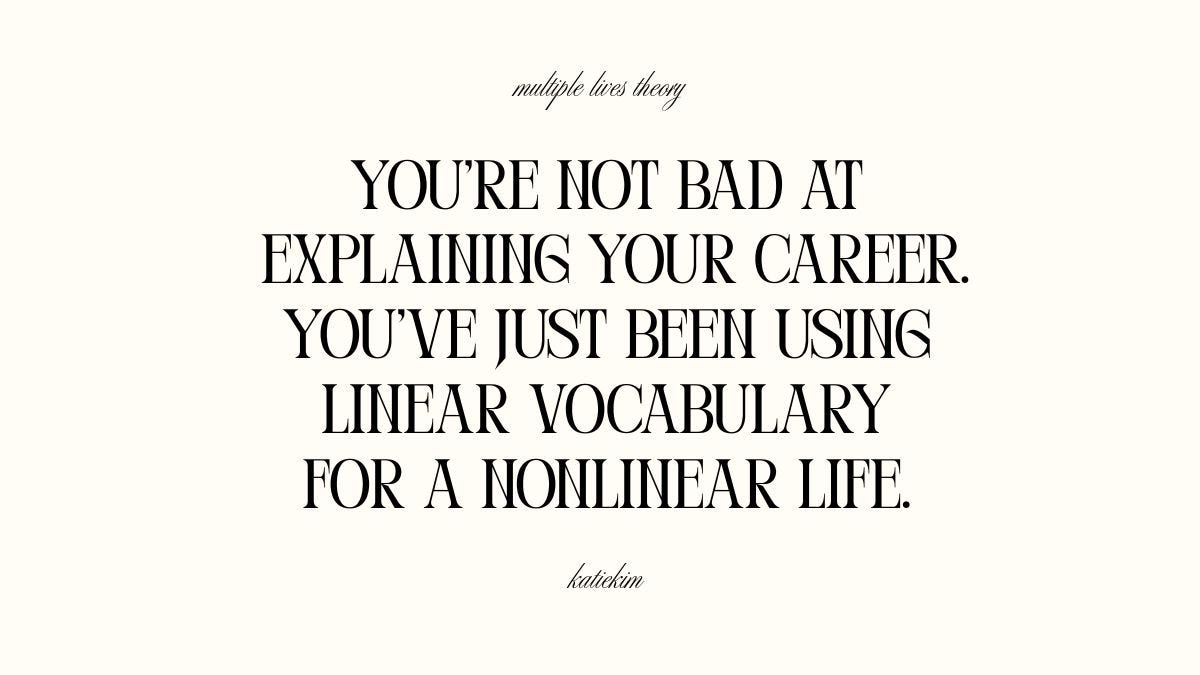
Here’s what I think was actually happening. I was trying to explain a nonlinear career in a linear vocabulary.
And that will always fail. Not because the career is confusing, but because the grammar is wrong.
The vocabulary we inherited for careers — the ladder, the track, the path, the promotion, the next step — assumes direction is singular. One thing leads to another in a sequence that can be read forwards and backwards without ambiguity. Promotion. Specialisation. Seniority. The career that makes sense and impressive in two words at a dinner party.
A nonlinear career has a different structure. It accumulates rather than ascends. Each version of you isn’t a detour from the main path — it’s a deposit. The work you did in one place is still running in the background of everything that comes after. The skills, the knowledge, the way you think, the experience, the perspective — they all compound. They don’t disappear when the job title changes.
The problem is that compounding doesn’t photograph well. You can’t put it in a LinkedIn headline.
So you can’t help but feel that you have to explain. And in the explaining, you preface, you apologise, or you have to back yourself up so many times. You call things mistakes or ‘trying’ it before anyone has implied they are. You use the word unconventional as a buffer. You make it smaller than it is to fit the container someone else has handed you.
I won’t lie, overtime I was personally draining myself from always making others comfortable, or anticipating the reaction they’ll have once they hear something unconventional or perhaps even unfamiliar in their world. Then one day I decided on a specific moment to stop doing this. Not a dramatic decision. More of it was not worth the energy economics. So on another day when someone asked and I decided to give them the full answer. The whole thing, without the buffer — just owning it.
And they were pleasantly interested. More interested, maybe, than they would have been in the clean version.
The nonlinear career isn’t confusing. You’ve just been using the wrong vocabulary for it. The right vocabulary sounds less like an apology and more like an argument. It knows that the gaps were when you were figuring something out. That the change of direction was directional, actually — just not in the way the original plan anticipated. That doing three things is not the same as doing none of them well.
When you stopped apologizing for the gaps, the gaps became the story.
And the story is more interesting than the straight line.
I’m still working on saying it quickly and owning it. Still editing it down to something that fits a conversation. But I’ve stopped treating the career itself as the thing that needs fixing.
The vocabulary needed fixing. Not the years.
If you’ve ever pre-apologised for your career before anyone asked — I want to hear what your actual story sounds like. Reply here.
This resonated deeply.
For years I felt like I had to explain myself: Pilates teacher, entrepreneur, coach, speaker, team builder, movement creator. I would simplify my story so it made sense to other people, as if the fact that it didn't fit neatly into one box needed justification.
What I've come to realize is that none of those chapters were detours. They all shaped how I see the world and how I work today. The skills compounded, even when the path didn't look linear from the outside.
"The vocabulary needed fixing. Not the years."
You put something into words that I have been feelng for a long time.
I feel like we’re all taught to explain ourselves in the neatest, most digestible way possible, especially when it comes to careers, but real life rarely works like that. I love the idea that every experience is a deposit, not a detour. That completely reframes the pressure to make everything “make sense” on paper. The line about the vocabulary needing fixing, not the years, really stayed with me. Such a thoughtful read.