


Hi, I’m Katie! Welcome to The Multiple Lives Theory, where I write for people who have outgrown a version of a life they worked hard to build. Essays from inside the transition, not the other side. Thursdays and Sundays.
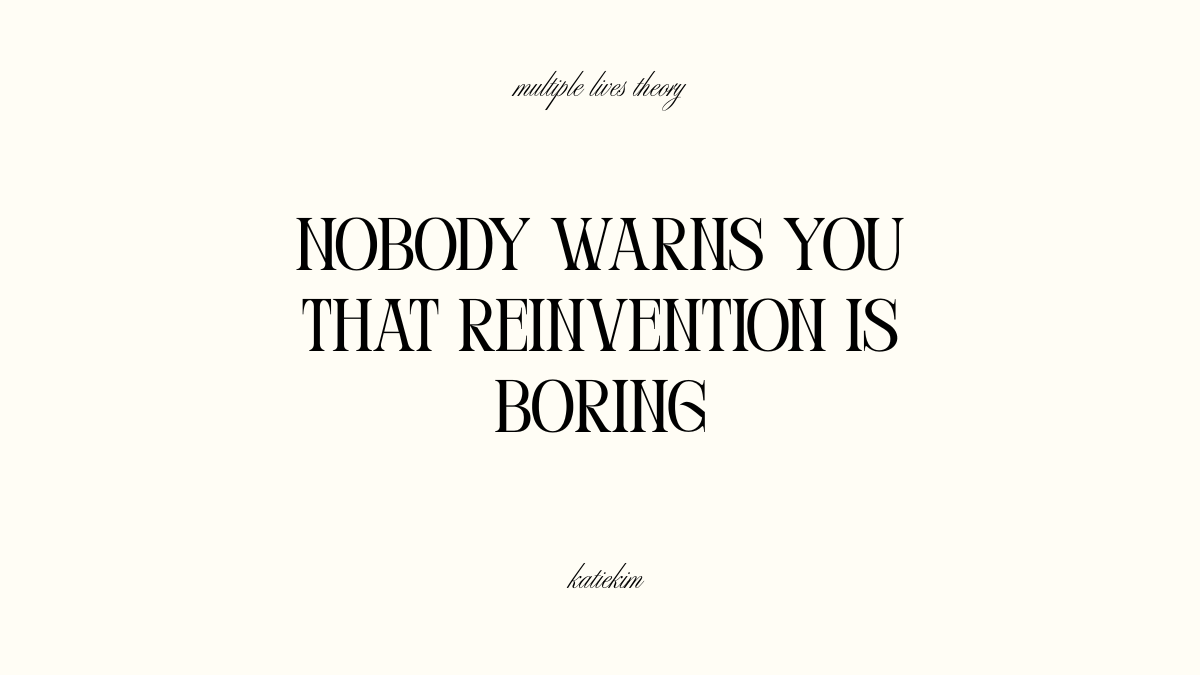
Since starting this journey, I’ve been thinking about the part of changing your life that nobody puts in the warning, and truthfully, it isn’t the scary part.
Everyone warned me about the fear. The money, the uncertainty, the what if this doesn’t work. People were generous about it, repeatedly, and they meant well. I had a number in a spreadsheet and a rough plan for what I’d do when the number ran out.
What nobody warned me about is that most of it would be boring.
Simply put. Just boring.
There’s a difference and I did not know it until I was sitting in it.
A boring day goes like this. You get up, you make coffee, you sit down, and you have three things to do that would take about forty minutes if you did them one after the other.
You stretch them across seven hours, because there’s nothing else in the day and stopping at half past ten feels like cheating or procrastinating.
You reread your own website copy. You iterate on the design mockup. You send a follow-up. You wait. Somebody replies on Thursday. That was the week.
And you can’t really tell anyone. That’s the other half of it. Say you’re stuck on ideas and people start giving advice. Say you’re bored and it sounds like you’re complaining about the thing you asked for. And they continue to give advice.
And the other day someone asked me, “What was it like going full-time into your own business!?” They were genuinely excited for me. I thought I’d have some glorified answer to share. Like I’d finally figured life out. But after going through it, my answer was surprisingly ordinary.
I replied, “Honestly, it was pretty normal. It just felt like starting another project.”
I realized I’d built this version of it up in my head. That starting over would feel exciting all the time. That every day would come with some big breakthrough or sense of progress. But somewhere along the way, I stopped noticing the transition because it had simply become my life.
And maybe that’s the part we don’t talk about enough. The real work isn’t the highlight reel. It’s the ordinary process you wake up to and do again the next day, until one day you realize it was never supposed to feel like this extraordinary transformation.
It was just your life, changing one ordinary day at a time.
You’re just living it. That’s the part I don’t hear people talk about enough. The real work isn’t the highlight reel. It really lives in the ordinary process you wake up and do again the next day.
Why nobody wrote this down
I don’t think it’s a conspiracy of silence. I’m starting to think it’s a storytelling problem.
A decision is an event. It happens on one day. It has a before and an after and a moment in the middle, which means it fits in a paragraph, a post, a phone call to your mum. It is tellable.
The rebuild isn’t an event. It’s a process. It’s a duration. Eight months of steady, unremarkable work has no shape you can hand to somebody. Nothing in it changes fast enough to hold anyone’s attention, including your own.
So we have an enormous amount of writing about the leap and almost none about the year that follows it. Not because people are hiding it. Because there’s no way to make it interesting, and the people living through it are the least likely to have the energy to try.
What the boredom actually is
I assumed boredom meant there wasn’t enough going on.
But that wasn’t it.
There was plenty going on. Most days I had more things on the list than I could finish. There were ideas to chase, things to build, things I wanted to learn.
What had disappeared was the response in a what is considered ‘normal’ day to day system.
Think about a normal week in a job. Somebody replies to your message. A meeting happens and you say something and someone nods. A deadline arrives. Your manager says “looks good,” or says nothing, which somehow also counts. There are all these tiny moments throughout the day that tell you something is happening.
You’re moving. You’re contributing. You’re roughly where you’re supposed to be.
You don’t really notice them until they’re gone.
Because when you step away from that structure, the work doesn’t disappear with it. The list is still there. Sometimes it’s even longer.
But you do something and nothing happens. You do the next thing and nothing happens.
Nothing is going wrong either, which is the strange part. If it was failing, at least there would be something to respond to. Something to fix. Something telling you where you stood.
You didn’t get bored.
When you’re reinventing, especially when you’re building something new, those signals disappear before the new ones have had time to form. The work is still there. Sometimes there’s more of it than ever. But the response is delayed.
Which is why it doesn’t respond to the usual fixes. Working harder doesn’t create clarity. Working less doesn’t create momentum. I tried both, at some length, before I realised I wasn’t dealing with boredom at all.
And this is where people quit
Here’s the part I care about most, because it costs people the thing they wanted.
The boredom shows up somewhere around month four or five. It doesn’t announce itself as boredom. It turns up as flatness, and flatness looks a lot like evidence. Evidence that you chose wrong. That the thing you left was actually fine and you were being dramatic. That you’re not cut out for this after all.
It feels like information. It usually isn’t. It’s just what an unmetered week feels like from the inside.
Almost nobody quits during the frightening part.
They quit during the dull part, and they call it clarity.
I’ve watched three people do it in the last year, and each of them had a reasonable explanation ready. One of them was right, I think. I’m not sure about the other two, and I didn’t say anything at the time because who am I to come in and give an authoritative opinion.
Although I might be excusing myself here.
Some boredom is real information. If you’ve been bored for eleven months and nothing you change makes any difference, that might be the work rather than the transition, and no amount of reframing will fix a thing you don’t want to be doing.
I can’t always tell which one I’m in, and I’d be suspicious of anyone who says they can. The rough test I use is whether it lifts. Boredom that disappears the moment something interesting turns up is the transition. Boredom that sits there through the interesting parts as well is probably the work.
That isn’t a clean test. It requires the interesting parts to actually turn up, and sometimes they take their time.
What changes if you expect it
You stop reading it as a verdict. That’s most of the value, and it isn’t nothing.
The other thing that shifts I notice is the assumption underneath, which is that the dull stretch is an interval. The bit between the decision and the life. It isn’t.
Ordinary days were always going to be the majority, in this life and in the one before it.
The old job and the new job had them too. They just had meetings in them, and the meetings made the week feel like something was occurring.
Which means the thing worth building isn’t more excitement. It’s some way of registering a week that doesn’t depend on anybody else noticing it. I’m not going to pretend I’ve nailed that. I have a system I like for about three weeks at a time.
And there’s a version of this where the boredom is a good sign. A settled week is boring almost by definition. Nothing urgent, nothing on fire, nobody needing anything at nine at night. It might just be what stable feels like before you’re used to it. Though I notice I want that to be true, which is usually a reason to hold it loosely.
What this leaves you with
Nobody warns you about this because it doesn’t sound like a warning.
One day, reinvention becomes ordinary.
Eight months in, most of my days are admin, waiting, sending outreach emails, and work that compounds so quietly it barely feels like progress.
However, I’d choose it again tomorrow. Maybe that’s the point.
Reinvention isn’t supposed to stay exciting forever. Eventually, it starts feeling like your actual life.
And strangely, I am comfortable normalizing it and admitting it’s another day in the mundane life of.
What’s the most mundane part of your week right now, and what did you think it was going to be instead?
More from Multiple Lives Theory:
The hardest part of a nonlinear career isnt’ building it. It’s explaining it
The five-year plan is dead. The questions haven’t caught up.
🌱 New here?
The Multiple Lives Theory is for anyone who has outgrown a version of a life they worked hard to build. Thursdays are the personal essays. Sundays are the frameworks. Both are free.
Paid members get the Reinvention Library, which is where the tools live. Decision maps, workbooks, Notion dashboards and the step by step versions of the frameworks that appear here in outline.
Written from inside the transition, not the other side.

Yes – it's good when something feels routine. It means the new is now our default, and we can make our next move to grow and expand!